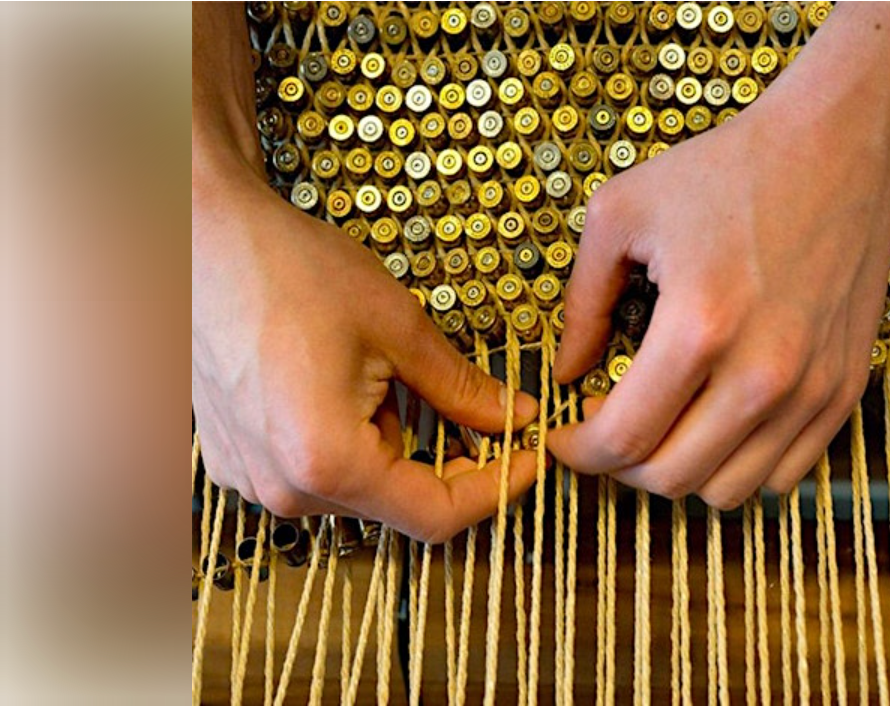
The Memorial for Those Who Did Not Fall in War
Contemporary Art Exhibition | International Symposium | Cultural Program
Free with Pre-Registration (French & English)
The Memorial For Those Who Did Not Fall In War (MNW) reimagines the emblem of war’s suffering, the memorial, for a world in which “peace” no longer shields anyone from the harms and responsibilities of military violence. Nations that see themselves as peaceful continue to participate in the global arms trade and in military interventions that fuel wars and genocides. As a result, even those who have never set foot in a conflict zone are shaped by war’s psychological, ecological, and political consequences, whether distant or historical.
Refusing to remain unwilling partners and silent sufferers of this destruction, MNW gathers collaborators from across the globe, from the world's leading contemporary artists and theorists to writers, performers, and filmmakers, around a shared conviction: as long as we are all harmed by war and participate in the systems that sustain conflict, none of us can truly be at peace. From this position, the MNW invites audiences to question their most basic assumptions about how peace and war are perceived, experienced, and imagined, and to develop new cultural, visual, and intellectual languages through which to understand what it means to live 'at peace' and 'at war' in the twenty-first century.
The Paris launch will unfold across three interconnected dimensions: a contemporary art exhibition, an international symposium, and a public cultural program of performances, readings, and screenings. Together, these formats form the foundation of MNW’s long-term model, in which research, artistic practice, and public pedagogy are inseparable.
This inaugural event marks the beginning of the Memorial’s ongoing journey across regions and continents. Conceived as a drifting, evolving institution rather than a fixed monument, MNW will continue to travel globally to each region of the world, engaging local histories, conflicts, and forms of memory, while building conversations across frontiers on responsibility, peace, and ecological justice.
At a time when war is increasingly normalized as distant, inevitable, or abstract, The Memorial for Those Who Did Not Fall in War insists on a different ethical and cultural stance: that peace cannot be understood as the absence of direct violence, and that responsibility does not stop at national borders.
—
Day 1: Feb. 11, 2026
09:40–10:15 Gathering
10:15–10:30 Acknowledgments and Project Vision
Dr. Hadas Zahavi, Director of The Memorial for Those Who Did Not Fall in War (Columbia University)
10:30–12:00 Opening Lecture and Discussion: Témoigner pour le témoin
Prof. Georges Didi-Huberman (EHESS)
12:00–13:30 Lunch Break
13:30–15:15 Opening Panel: War in Disguise
Prof. Nina Berman (Columbia University, Fellow of the Institute for Ideas and Imagination)
Prof. Françoise Vergès (University of London)
Kapwani Kiwanga
15:15–15:30 Coffee Break
15:30–16:30 Literary Conversation: Algeria in France Today
Leïla Sebbar
Yahia Belaskri
16:30–16:45 Refreshment Break
16:45–17:45 Artist Talk: Unlearning War Through Images
Hito Steyerl
Prof. Lorie Novak (NYU)
Session Chair: Laura Lema Silva
18:00–19:00 Exhibition Opening and Artistic Performance
What Have I Done to You? Baptist Coelho
19:00–20:00 A Dance Performance with Live Piano
Ablaye Birahim Diop
Nikias Imhoof
—
Day 2: Feb. 12, 2026
09:30–10:00 Gathering
10:00–11:30 Roundtable: War as a System of Spaces
Research Director at the CNRS Prof. Sarga Moussa (THALIM, CNRS): Rendre visibles et audibles les blessés de la guerre dans Un souvenir de Solférino (1862) d'Henry Dunant; Une rhétorique de l'horreur au service d'un humanisme moderne d'inspiration chrétienne
Prof. Luba Jurgenson (Sorbonne Université): Paysage de guerre, paysage de paix? À propos d'une zone minière/concentrationnaire en République tchèque
Prof. Thomas Hippler (University of Caen): Bombarder pour la paix? La guerre aérienne et l’ordre international
Session Chair: Dr. Guido Furci (Université Sorbonne Nouvelle)
11:30–11:45 Coffee Break
11:45–13:15 Interactive Session: Peace in Practice
Majd Abdel Hamid: Texture of Memory
Prof. Yann Toma (Sorbonne): L’Air de la guerre
Dr. Barbara Polla (ULB): Hospitalité et paix : un effort perpétuel
13:15–14:30 Lunch Break
14:30–15:15 Performance
Inutile, Meltem Yildiz
15:15–15:30 Coffee Break
15:30–17:00 Roundtable: Peace After the Algorithm
Prof. Alexandre Gefen (THALIM CNRS): Le langage et la guerre à l’heure de l’IA générative
Lesia Khomenko: Working on User-Generated Footage from the Russian-Ukrainian War
Warren Neidich: Peace Machine: The Brain Without Organs
17:00–17:15 Short Break
17:15–18:15 Workshop
Julieta Aranda
18:15–19h15 Refreshment Break
19:15–20:45 Film Screening: Nikah, followed by Q&A
Mukaddas Mijit
Bastien Ehouzan
—
Day 3: Feb. 13, 2026
09:30–10:00 Gathering & Morning Coffee
10:00–11:30 Closing Panel: Whose War Is It, Anyway?
Prof. Stéphane Gerson (NYU): Quand la guerre se terre sous l’aventure
Prof. Philippe Mesnard (Université Clermont Auvergne): De quelle imagination parlons-nous ?
Prof. Catherine Brun (THALIM, Université Sorbonne Nouvelle): « Il paraît que nous sommes en guerre »
Session Chair: Dr. Pauline Hachette (Université Paris 8)
11:30–11:45 Coffee Break
11:45–12:45 Artist Conversation
Paola Yacoub, La guerre est monotone
12:45–13:30 Closing Workshop
Dr. Dalia Abu Sbitan (THALIM, CNRS): Diagnosing War: A Participatory Session in Narrative Diagnostics
—
Board
Hadas Zahavi (Director), Alexandre Gefen, Sarga Moussa, Sarah Cole, Marianne Hirsch, Bruno Bosteels, Madeleine Dobie, Nina Berman, Joerg M. Schaefer, David C. Johnston, Thomas W. Dodman.
—
Participating Artists
Hito Steyerl (Germany), Kapwani Kiwanga (Canada/Tanzania), Julieta Aranda (Mexico/Germany), Majd Abdel Hamid (Palestine/Syria), Lesia Khomenko (Ukraine), Louis-Cyprien Rials (Iraq/France), Nina Berman (USA), Lorie Novak (USA), Yann Toma (France), Paola Yacoub (Lebanon/France), Vera Kox (Luxembourg/Germany), Meltem Yildiz (Bakur Kurdistan), Baptist Coelho (India), Warren Neidich (USA), Syd Krochmalny (Argentina), Detext (Spain), Manuela Morgaine (France).
—
The organizers wish to express their sincere gratitude to NYU Maison Française, Columbia University Society of Senior Scholars, Université Paris-Est Créteil, Centre for Literary and Intermedial Crossings Vrije Universiteit Brussel, Cloud Seven, Eric Mouchet Gallery, The Slip, Seize Avril, Galerie Poggi, Kultur | lx – Arts Council Luxembourg, Maison du Grand-Duché de Luxembourg, Marfa Projects, Ceysson & Bénétière, L’Endroit, Les Films du Bal, as well as to the individuals Lindsey Michelle Schram, Betti-Sue Hertz, Mickaël Faure, Frédéric de Goldschmidt, Eric Mouchet and Corinne Diserens, for their generous support and collaboration.