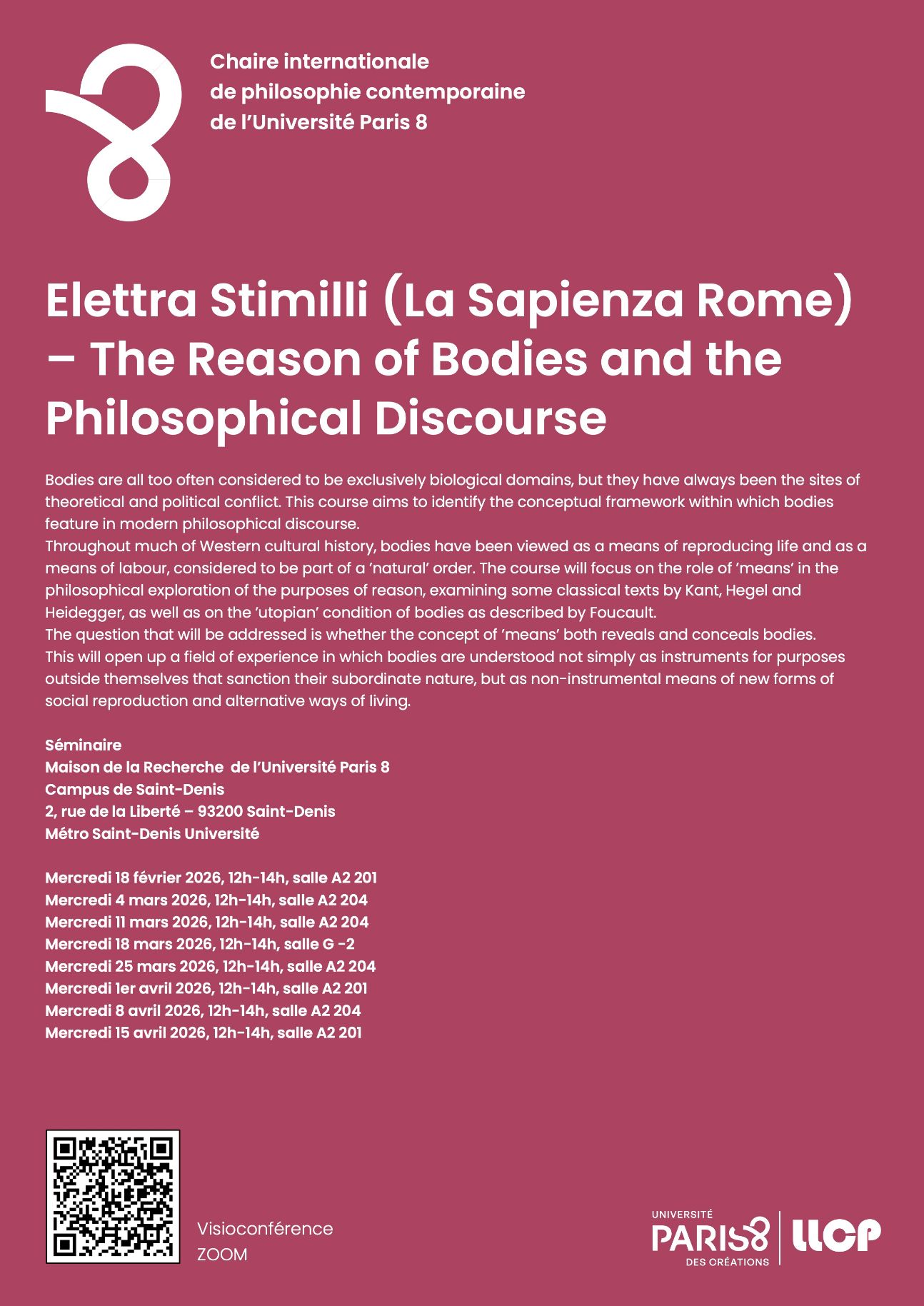
The Reasons of Bodies and the Philosophical Discourse. Conf. d'Elettra Stimilli (Paris 8, Saint-Denis)
Chaire internationale de philosophie contemporaine de l’Université Paris 8
Séminaire 2025-2026
Elettra Stimilli
(Università degli Studi "La Sapienza" di Roma)
The Reasons of Bodies and the Philosophical Discourse
Mercredi 12h-14h (8 séances)
Maison de la Recherche de l’Université Paris 8
Campus de Saint-Denis
2 rue de la Liberté, 93200 Saint-Denis (M° Saint-Denis Université)
Visioconférence :
https://univ-paris8.zoom.us/j/95718253262?pwd=gIP7vY4Zj0ylKOU9KufbMUYp6BoxLV.1
– Mercredi 18 février 2026, 12h-14h, salle A2 201
– Mercredi 4 mars 2026, 12h-14h, salle A2 204
– Mercredi 11 mars 2026, 12h-14h, salle A2 204
– Mercredi 18 mars 2026, 12h-14h, salle G -2
– Mercredi 25 mars 2026, 12h-14h, salle A2 204
– Mercredi 1er avril 2026, 12h-14h, salle A2 201
– Mercredi 8 avril 2026, 12h-14h, salle A2 204
– Mercredi 15 avril 2026, 12h-14h, salle A2 201
Bodies are all too often considered to be exclusively biological domains, but they have always been the sites of theoretical and political conflict. This course aims to identify the conceptual framework within which bodies feature in modern philosophical discourse.
Throughout much of Western cultural history, bodies have been viewed as a means of reproducing life and as a means of labour, considered to be part of a ’natural’ order. The course will focus on the role of ’means’ in the philosophical exploration of the purposes of reason, examining some classical texts by Kant, Hegel and Heidegger, as well as on the ’utopian’ condition of bodies as described by Foucault.
The question that will be addressed is whether the concept of ’means’ both reveals and conceals bodies.
This will open up a field of experience in which bodies are understood not simply as instruments for purposes outside themselves that sanction their subordinate nature, but as non-instrumental means of new forms of social reproduction and alternative ways of living.