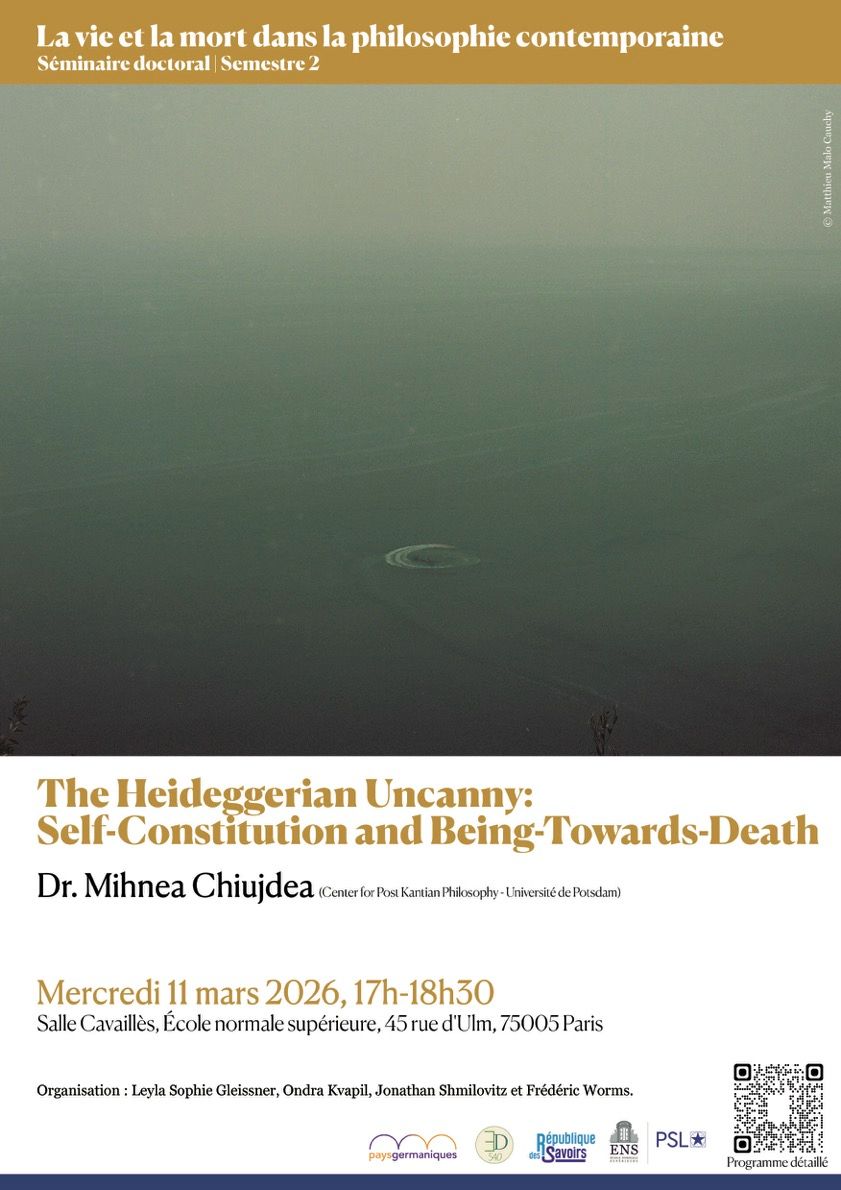
The Heideggerian Uncanny: Self-Constitution and Being-Towards-Death. Conf. de Mihnea Chiujdea (ENS Paris)
Nous invitons des collègues, des doctorant·es ainsi que des étudiant·es en master à participer à une séance spéciale de notre séminaire « La vie et la mort dans la philosophie contemporaine », qui a lieu les mercredis à 17 h à l’École normale supérieure (Paris).
Pour cette séance, nous accueillerons le Dr. Mihnea Chiujdea (Center for Post-Kantian Philosophy – Université de Potsdam), qui donnera une conférence intitulée « The Heideggerian Uncanny: Self-Constitution and Being-Towards-Death ». La séance se déroulera en anglais.
Lieu et horaire : La séance se tiendra de 17 h à 18 h 30 dans la salle Cavaillès, à l’ENS (45 rue d’Ulm, 75005 Paris).
Organisation : Leyla Sophie Gleissner, Ondra Kvapil, Jonathan Shmilovitz, Frédéric Worms
Pour plus d'informations : https://paysgermaniques.fr/events/la-vie-et-la-mort-seminaire-doctoral/ ; https://republique-des-savoirs.fr/events/event/seminaire-doctoral-la-vie-et-la-mort/
Inscriptions : Nous vous prions de bien vouloir vous inscrire par courriel. Les contacts sont disponibles sur les sites indiqués.
Dr. Mihnea Chiujdea : « The Heideggerian Uncanny: Self-Constitution and Being-Towards-Death »
"In this talk I suggest a reassessment of the significance of the uncanny in Heidegger’s work. First, in keeping with the model of Dasein’s self-constitution I take Heidegger to offer, I develop two problems – acting in light of norms and stagnation. These will enable me to highlight the need for the discontinuity that I later show that the experience of the uncanny is able to provide and the role played by being-towards-death or self-undermining. I then look at Heidegger’s explicit treatment of the uncanny, distinguishing between an existential structure of the uncanny and an episodic form thereof. The episodic uncanny not only has explanatory priority. It is also important because it provides a disposition to self-undermine. In turn, selfundermining is involved by the solution to the two problems I opened with. In the last part of the talk, I ask how the episodic uncanny can bring about being-towards-death. I suggest that it involves a transformative aesthetic experience."