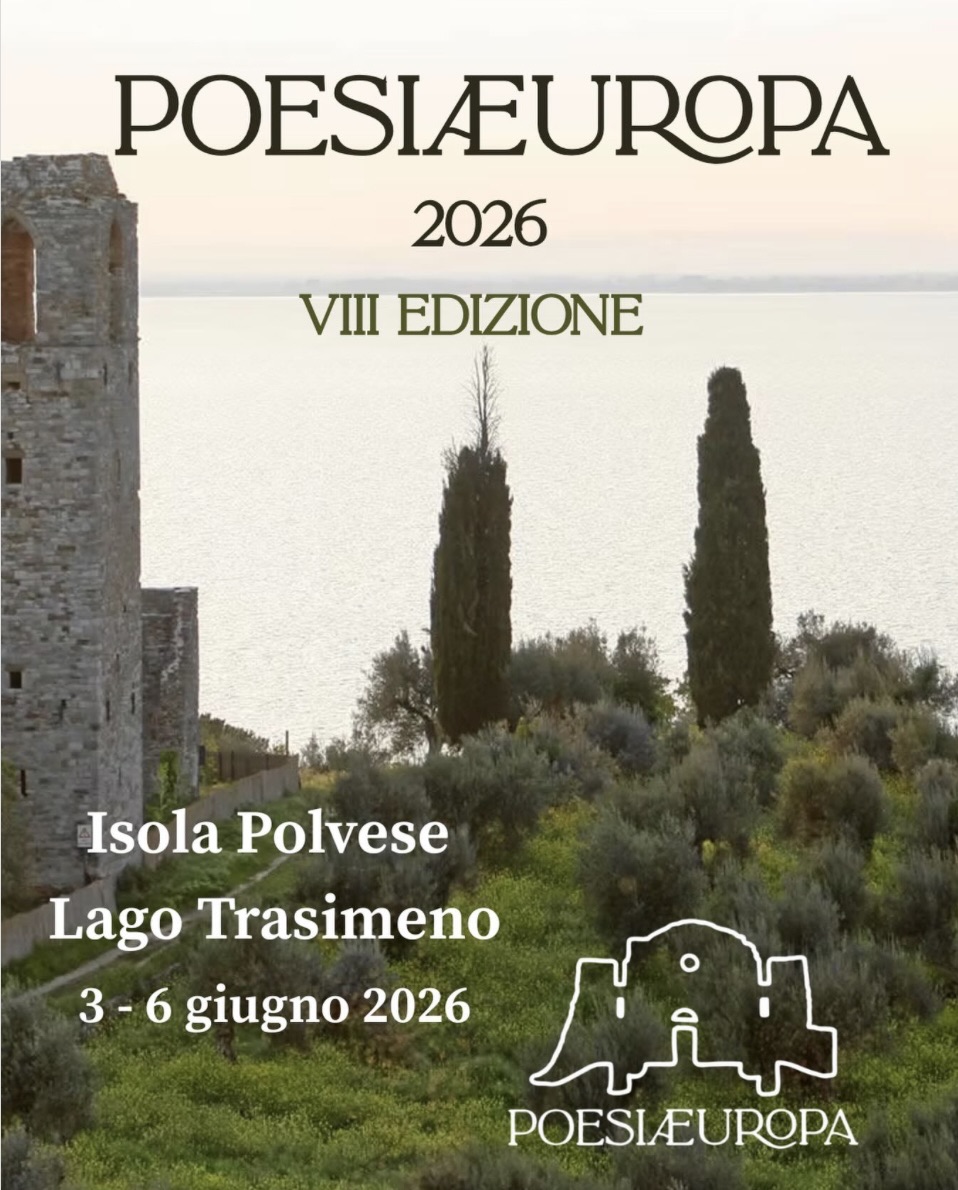
Poesiæuropa - VIII edition
Polvese Island, Lake Trasimeno, Italy
June 3- 6, 2026
Call for fellowship applications
Poesiæuropa offers a reflection on humanistic culture starting from the voices of poetry, with the goal to reconsider the value of our humanistic and spiritual roots and build visions for the future together. In 2026, the project will reach its eighth edition and involve fellows (students, scholars, and authors) from different countries taking part in a special school. The school will be held on Isola Polvese on Lake Trasimeno (Perugia), Italy, on the border between Umbria and Tuscany, from June 3 to 6, 2026 (four full days), and will consist of various events:
• lectio magistralis;
• dialogue forum;
• workshops;
• panels with presentations of the fellows' work;
• readings.
For the 2026 edition, contributions relating to the following thematic areas are requested:
1) ECHOES FROM THE FUTURE – This focus area is dedicated to a broad reflection on the theme of the future in written works from 2020 onwards, in poetry and fiction. In particular, we will focus on three aspects through which the future can be interpreted:
• The theme of the future is usually given a prominent role in works belonging to the science fiction genre, which can be utopian or dystopian in nature, foreshadowing paradises or apocalypses. We would also like to draw attention to writings that represent the idea of the future as part of an existential and reflective condition that does not superimpose images or narratives of a wonderful or destructive tomorrow on the experience of recent years, but that is rooted precisely in the experience of recent years. A future that does not detract from the present as a real historical condition, but that rather aims to bring about a heightened critical awareness of history;
• How can Future Studies interact with and/or influence the literature being written today? Sticking to the investigations of Future Studies, oriented towards a systematic and interdisciplinary study of the possible and the probable, with the aim of foreshadowing and anticipating social, cultural, and technological changes, we turn our attention to various synergies between: a) literary writing and extra-literary and non-humanistic fields (science, mathematics, economics, etc.); b) written language and the concept of plurality – since thinking about the future and its possibilities/probabilities implies a plural horizon – and therefore how writing can take on a plural focus in the ways it represents the subject/individual, space, time, and in its use of style;
• The theme of the future opens up a range of interactions between writing, artistic-media-digital forms, and AI. We are interested in reflections on the ways in which the figure of the author can be outlined, for example, in its interactions with artistic creation tools, dissemination channels, and contexts for the representation of works currently being developed at the editorial, media, and museum levels.
2) WORK – This focus area is dedicated to the ways in which literature has addressed the theme of work, especially in its historical and social connotations. We will consider proposals that address the issue in the following terms:
• work as a writing subject (texts that explicitly refer to work, with particular attention to the various phenomena of work, the labor market, changes in work, ways in which individuals value work, etc.) and how it has influenced texts within specific poetics, with a preference for works published since 2000;
• authors who have written critical essays and/or journalistic pieces on the theme of work, if and how these reflections in prose interact with their poetry;
• texts that address the theme of work and expectations, i.e., how readers have interacted with these types of texts, how they appear in the contexts in which they are disseminated (books, newspapers, the web, social media, etc.);
• how does an author conceive of their work? Do they consider work to be a crucial element of their poetics? Added to these questions is a reflection on the idea of writing as work, a creative act, and a material condition: can writing today be considered work with educational and social implications, but also productive/innovative, etc.?
3) NOISE – This focus is dedicated to the interactions between the language of poetry and scientific studies on noise. We will consider works that reflect on the interactions between writing and the values attributed to noise such as:
• the relationship between poetry and the distinctions between sound and noise, harmony and disharmony, balance and imbalance, polish and scrap, soundscape and noisescape, composition/form/style and anti-composition/anti-form/anti-style;
• to this first guideline, however, we would like to add a second one in which the distinctions indicated above overlap in hybrid textures: sound and noise appear consubstantial with a composite atmosphere, like alternations of pulsating cosmic bodies, evolving, in the making; furthermore, they appear to be stratified in themselves (sound and its tones, high/-low, light/-dark; noise and its ranges, for example from white noise to brown noise);
• Noise in poetry transcends composition and style: the polarities, as antithetical as they are complementary, between sound and noise lead us to consider the ideological implications of writing poetry, which are relevant to moral judgments about useful/useless, necessary/unnecessary and, in an aesthetic sense, beautiful/ugly, but which also include judgments about the usefulness/uselessness of beauty and the significance/insignificance of ugliness (for example, starting from the historical distinctions between beauty and the sublime). Finally, a question: can we say that, as things stand at present, the field of poetry is indicative of the fact that, on a larger scale, value judgments are being replaced by judgments of utility?
—
To apply for a fellowship, which includes accommodation for the duration of the school and the presentation of your academic and/or creative work, please send your curriculum vitaeand a 500-word abstract of the academic or artistic work you intend to present to info@spaziohumanities.it by March 2, 2026. The results will be announced by March 12, 2026.
Participation is open to everyone: there are no restrictions on age, professional occupation, or origin. Participation in Poesiæuropa also entitles participants to receive a certificate of attendance valid as a refresher/training course. Willingness to stay for the entire duration of the event will be rewarded in the evaluation of application.
The contributions selected by the scientific committee will be published in a conference proceedings volume sponsored by the Department of Literature and Languages of the University of Perugia in collaboration with Arizona State University and Colby College.
Each fellowship will cover all accommodation and meal costs for a shared room at a partner facility. To reserve a single or shared room at Hotel Villa Polvese Resort for the entire duration of the event, or a single room at a partner facility, a contribution is required, whose amount will be communicated upon request. In order to facilitate logistics, please indicate in your application your preferred type of accommodation (shared or single).
Poesiaeuropa 2026 undertakes to reserve 2 fully funded scholarships for writers, poets, or artists who wish to submit their work.
Students who wish to attend classes and experience the school without submitting study projects will be issued a certificate of participation, which requires attendance at a minimum of 2 out of 4 training days. If students also wish to stay overnight, please specify this request and we will provide them with a list of affiliated accommodation facilities.
No travel expenses will be reimbursed.
—
For further information, please contact:
—
Poesiaeuropa is an initiative under the High Patronage of the European Parliament and is organized in collaboration with Arci Spazio Humanities. Partners include: University of Perugia, Umbria Region, Goethe Institut, Instituto Camões, Austrian Cultural Forum, Embassy of Ireland, Hungarian Academy, Danish Art Foundation, Colby College, Arizona State University, and Virginia G. Piper Center for Creative Writing. While awaiting the program, more information is available on our website: www.spaziohumanities.it/poesiaeuropa