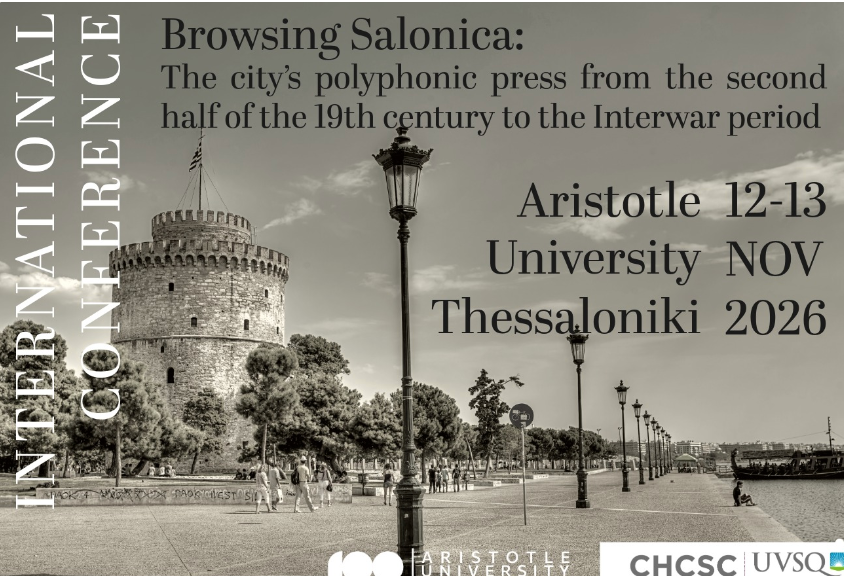
Browsing Salonica. The city’s polyphonic press from the second half of the 19th century to the Interwar period
International Conference
“Browsing Salonica : The city’s polyphonic press from the second half of the 19th century to the Interwar period”
Date : 12-13 November 2026
Place : Aristotle University of Thessaloniki
Organisers : Aristotle University of Thessaloniki, Réseau Transfopress-CHCSC/Paris-Saclay
Organising Committee : Georgios Antoniou (Aristotle University of Thessaloniki), Kyriakos Chatzikyriakidis (Aristotle University of Thessaloniki), Diana Cooper-Richet (Réseau Transfopress-CHCSC/Paris-Saclay), Nikos Panagiotou (Aristotle University of Thessaloniki), Nicolas Pitsos (Réseau Transfopress-CHCSC/Paris-Saclay)
A religious and linguistic mosaic, known as the capital of ‘refugees’ and a commercial crossroads, Thessaloniki was a flagship city of the Ottoman Empire at the turn of the 20th century and one of Greece's most important urban centres during the Interwar period. Within its cosmopolitan society, a multilingual press emerged during this period as populations moved and demographic changes took place between its status as an Ottoman city and its integration into the Greek state. Titles in Greek and Ottoman Turkish coexisted with those in French, Judeo-Spanish (Ladino), Armenian, English, Bulgarian, Serbian or Albanian, highlighting the city's position as a major publishing centre in Southeastern Europe and the Eastern Mediterranean.
The conference aims to show how the study of this polyphonic press, published in Thessaloniki, contributes to a better understanding of its topography, its sociology and the evolution of its cultural landscape, paving the way for a plural history of the city of Thessaloniki.
More specifically, the conference aims to:
· Map the multilingual press as a proto-media ecosystem, examining its role in shaping public opinion, community identity, and intercommunal dialogue.
· Identify the sites and networks involved in the production and circulation of newspapers, exploring how printing and distribution infrastructures supported emerging journalistic fields.
· Trace the individuals who founded, supplied, and sustained these publications, linking them to broader transnational communication circuits.
· Map the linguistic diversity and publishing formats of Thessaloniki’s press.
· Analyse the cultural and economic ecosystems that emerged around the press, including advertising, readership, and professional practices.
Proposed Themes
Participants are invited to address, among others, the following themes:
· Overviews by language or period of publication.
· Cross-cutting studies on press functions and interactions.
· Corpus building: cataloguing titles and mapping the city’s publishing landscape.
· Prosopographical studies of editors, publishers, and printers.
· Analyses of content in relation to Thessaloniki’s socio-cultural life.
· Reconstruction of networks connecting people, ideas, and media models.
· Studies of cultural transfer and inter-linguistic dialogue among publications.
· Reception and influence of Thessaloniki’s press within broader Balkan and Mediterranean media spaces.
The event will bring together historians of the press, migration, and urban life, as well as librarians, archivists, and museum professionals working on cataloguing, conservation, and valorisation of press collections.
Submission terms
If you would like to take part in this conference, to be held in Thessaloniki in November 2026, please send your proposal in English, up to 250 words, followed by a brief bio-bibliographical presentation, to the following address transfopresssalonique2026@gmail.com by 28 February 2026.
Notification of acceptance will be sent by the end of March 2026. The working language of the meeting will be English.
Scientific Committee
Maria José Ruiz Acosta (University of Sevilla)
Georgios Antoniou (Aristotle University of Thessaloniki)
Kyriakos Chatzikyriakidis (Aristotle University of Thessaloniki)
Diana Cooper-Richet (CHCSC/Paris-Saclay)
Ons Debbech (Université Paris 8)
Isabelle Felici (University of Montpellier)
Lampros Flitouris (University of Ioannina)
Aleksandra Kolakovic (IEP, Belgrade)
Iakovos Michailidis (Aristotle University of Thessaloniki)
Nikos Panagiotou (Aristotle University of Thessaloniki)
Nicolas Pitsos (CHCSC/Paris-Saclay)
Isabelle Richet (Université Paris Cité)
Evanghelia Stead (CHCSC/Paris-Saclay)
Özgür Türesay (EPHE)