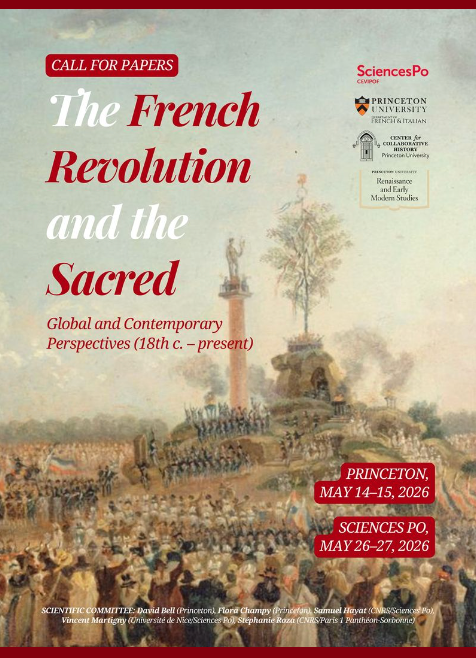
La Révolution française et le Sacré. Perspectives globales et contemporaines, du XVIIIᵉ s. à nos jours (Princeton & Sciences Po Paris)
“Revolution continues Christianity, and it contradicts it. It is, at the same time, its heir and its adversary.” — Jules Michelet (1848)
In the years leading up to the bicentenary commemorations of 1989, a new liberal interpretation of the French Revolution challenged a long-lived socialist one. In contrast to the Marxist view of a “bourgeois revolution” with popular support (Jaurès, 1922-1924; Soboul, 1974; Mazauric, 1988), the liberal historiography has recurrently emphasized the role of “revolutionary ideology” and the “collective mentality” which led to the episode of the “Terror” (Furet, 2009). While Michel Vovelle attempted to fill the gaps by writing a social history of religious conflicts (Vovelle, 1988), we might take the end of Cold War binary frameworks as an opportunity to move beyond this long-lasting interpretive divide, and to reinvestigate how the Revolution transformed ideas of the sacred and has itself been sacralized.
Moreover, while modernity has long been equated with the fading of the sacred from our “horizons of expectation” (Koselleck, 1979) and with an increasingly disenchanted world (Gauchet, 1985), the worldwide resurgence of religion over recent decades has profoundly unsettled that narrative. This development calls for a new genealogy of modernity, to which this colloquium contributes by examining the role of the sacred both during the French Revolution and in its contemporary legacy, from a global, interdisciplinary, and contemporary perspective—especially as 2026 will mark the 250th anniversary of the U.S. Declaration of Independence.
We invite graduate students as well as established scholars to contribute to this reflection by submitting 20-minute papers addressing this theme. The colloquium will be held in two parts: at Princeton on 14–15 May and at Sciences Po on 26–27 May, 2026. Presentations may be delivered in English or French, at either institution. Participants are encouraged to attend both sessions if possible, though a hybrid option will also be available.
In their contributions, participants are encouraged to emphasize:
- Chronology: We seek contributions that adopt a diachronic perspective. Papers engaging with the role of the sacred in the making of the Revolution are welcome to explore the revolutionary period directly. Regarding the sacralization of the Revolution itself, we note that Alice Gérard’s landmark study (Gérard, 1970) closes in the late 1960s, and that while significant work has been done on the Revolution’s reception through the 1989 bicentenary (Kaplan, 1993; Garcia, 2000; Martigny,
2016), far less research has examined the period after 1989. We therefore particularly encourage proposals focusing on the post-1989 era. - Geography: We strongly encourage participants to engage with international and transatlantic dimensions, following recent historiography (Desan, Nelson, and Hunt, 2013; Ducange, 2014). We therefore invite comparative approaches reflecting on the connections and contrasts between the French, American (Higonnet, 1988; Dunn, 1996), and Caribbean (Gaspar & Geggus, 2003; Dubois, 2004; White, 2012) revolutions in relation to the concept of the sacred.
- Interdisciplinary approaches: Finally, we welcome contributions that cross disciplinary boundaries, particularly between history, political theory, and literature. Revolutionary sacrality was not only theorized or practiced, but also represented, reimagined, and transmitted through cultural forms. As Roland Barthes remarked, revolutionary writing constituted the “entelechy of the revolutionary legend” (Barthes, 1953). Literature, theater, and the arts may thus be seen as laboratories in which the myths of the Revolution were forged, contested, and continually reconfigured.
—
Instructions for Submissions
Submissions (title, abstract of 350 words, short bio) should be uploaded to the application form by February 8, 2026.
Please email revolutionsacred2026@protonmail.com with any questions.
Prospective participants will find below some further reflections and a bibliography to guide their proposals:
First, in considering the concept of sacrality, it might be useful to turn to the definition used by Emile Durkheim, who did not see the sacred as something grounded in a transcendent divinity, but rather as something defined through its opposition to the profane (Durkheim, 1912). It is therefore an inclusive concept: unlike Max Weber, who located religion in the realm of the supernatural (Weber, 1922), Durkheim’s notion of the sacred can apply to any object, practice, value, or event in the material world. Therefore, the relation between the French Revolution and the sacred might be approached from two different directions: first, by examining the role of the sacred within the Revolution itself; and second, by exploring the ways in which the Revolution was, in turn, sacralized in later periods.
The Sacred and the Making of the French Revolution
The French Revolution is commonly remembered as a period of virulent anti-religious violence, epitomized by the so-called “dechristianization” campaign of the “Terror.” From this perspective, interpreting it as a moment of religious affirmation may seem counterintuitive. Yet, as David Bell reminds us, the dozen years which separated the fall of the Bastille from the rise of Bonaparte constituted “the most intense political laboratory the world had ever known” (Bell, 2016), making any unequivocal interpretation of the period exceedingly difficult. In fact, contemporaries often perceived the Revolution in religious terms: Edmund Burke, for instance, observed that its leaders, though hostile to the Church, nonetheless “learned to talk against monks with the spirit of a monk” (Burke, 1790). Tocqueville also later described the event as assuming the form of a “religious revolution” (Tocqueville, 1856). Building on this intuition, scholars have repeatedly reassessed the role of the sacred in the development of the Revolution, showing how it could serve as a source of inspiration but also how traditional religion stood as a rejected model, in opposition to which revolutionaries generated new sacred concepts.
In discussing the role of the sacred as inspiration, early revolutionary historiography often mobilized the philosophy of history, with Michelet presenting a heroic portrait of women (Michelet, 1876) and soldiers, both part of the mythicized figure of the people making the Revolution a “religion of justice” (Michelet, 1889). More recent studies have explored the dialectic between the secular and the sacred, demonstrating how religious ideas shaped revolutionary experience and political culture (Tackett, 1986; Desan, 1990; Aston, 2000; Byrnes, 2014). Dupré (2004) highlights that revolutionary beliefs drew from both Enlightenment secularism and a “spiritual counterculture,” including Quietism or Lutheran Pietism. Other studies have stressed the religious roots of revolutionary ideals in the ancien régime (Kors, 1990; Van Kley, 1996), particularly Jansenism (Maire, 1998; Coleman, 2014) and Protestantism (Banks, 2016).
Previous scholarship has also demonstrated that many of the Revolution’s innovations carried a sacred dimension, following Albert Mathiez’s pioneering work on the origins of revolutionary cults (Mathiez, 1904). David Bell thus shows that the idea of the nation developed during the revolutionary period was inherently mystical, with the patrie appearing as a “second divinity” (Bell, 2011). That relationship appears particularly strongly in what Ozouf calls a “transfer of sacrality” from traditional religion to the Revolution, particularly as evidenced in festivals and other elements of political culture (Ozouf, 1976). The aim of such a transfer—which we can likewise trace through developments and innovations including the Cult of Reason, the revolutionary calendar, or the Festival of the Federation—was to stabilize the new order by endowing it with a particular, even supernatural, legitimacy (see also Hunt, 1984). In this vein, Flora Champy shows how Rousseau mobilized Antiquity as a sacred model that decisively shaped the Revolution and its later interpretations (Champy, 2022). Further historical examples include the Cult of the Supreme Being established in 1794, the quasi-religious veneration of Marat after his assassination—including the renaming of Montmartre as “Mont Marat”—or Condorcet’s scathing portrayal of Robespierre as a priest (Bell, 2020).
The Sacralization of the French Revolution
Going beyond the temporal framework of the Revolution itself also allows us to study the processes through which the Revolution became a myth with sacred undertones (Cobban, 1957). While this mythification was initially the work of the Revolution itself—the revolutionaries having enthusiastically embraced Fabre d’Églantine’s directive that “one must seize men’s imagination and govern it” (cited in Rosanvallon, 2004)—the myth continued to inspire successive generations of republicans through its association with ideals such as liberty, equality before the law, fraternity, citizenship, human rights, popular sovereignty or the general interest (Hazareesingh, 2011). Consequently, the language of republicans in 1848, 1870–1871, during 1914–1918, and in the Resistance drew directly on the patriotic tradition of the Revolution (Nabulsi, 1999; Hayat, 2014). Beyond the ideas this tradition represented, it contained an entire republican imagery that continued to be transmitted long after the Revolution (Agulhon, 1971–2001; Duprat and Delaporte, 2003).
However, recent developments suggest that the myth of the French Revolution may be undergoing significant reconfiguration, thus raising the question of its (de)sacralization. The historiographical battles that once animated it have largely subsided, and the Revolution today seems increasingly mainstreamed, absorbed into popular culture and folklore in ways that risk diluting its political potency (Poirson, 2014). Yet this claim can be challenged by the emergence of new, grassroots appropriations of the revolutionary legacy, as illustrated by the gilets jaunes movement (Hayat, 2024). More striking still is the rise of a “black legend” of the Revolution (Croustille & Ehrard, 1988), which classically crystallizes around figures and concepts long treated as repellent in French political debate—Robespierre (Ehrard, 1996; Jourdan, 1996), the “Terror” (Martin, 2012, 2017), or Jacobinism (Roubaud-Quashie & Simien, 2025)—which awaken the specter of division and civil conflict. More recently, critiques of Enlightenment philosophy (Lilti, 2019; Roza, 2020) have further unsettled the Revolution’s legacy, particularly with regard to contemporary concerns such as gender, class, and race.
Hence, by engaging with all these questions, this symposium aims to re-examine the foundational ties between Revolution and the sacred, while simultaneously participating in the ongoing historiographical reconfiguration of modernity.
—
Bibliography
AGULHON, Maurice,
Marianne au combat. L’imagerie et la symbolique républicaines de 1789 à 1880, Paris: Flammarion, coll. « Bibliothèque d’Ethnologie historique », 1979
Marianne au pouvoir. L’imagerie et la symbolique républicaines de 1880 à 1914, Paris: Flammarion, coll. « Histoires », 1989
Les métamorphoses de Marianne. L’imagerie et la symbolique républicaines de 1914 à nos jours, Paris: Flammarion, 2001.
ASTON, Nigel, Religion and Revolution in France, 1780–1804, Washington, D.C.: Catholic University of America Press, 2000.
AULARD François-Alphonse Aulard, Le culte de la raison et le culte de l’être suprême: 1793– 1794. Essai historique, Paris: F. Alcan, 1892.
BAKER, Keith Michael and EDELSTEIN, Dan (eds.), Scripting Revolution: A Historical Approach to the Comparative Study of Revolutions. Stanford, CA: Stanford University Press, 2015.
BANKS Bryan A., “The Protestant Origins of the French Revolution: Contextualizing Edgar Quinet in the Historiography of the Revolution, 1789–1865,” in Proceedings of the Western Society for French History, vol. 42, 2016.
BANKS Bryan A. and JOHNSON, Erica (eds.), The French Revolution and Religion in Global Perspective: Freedom and Faith, London, Palgrave Macmillan, 2017.
BARTHES, Roland, Le Degré zéro de l’écriture, Éditions du Seuil, Paris, 1953.
BELL, David A.,
The Cult of the Nation in France: Inventing Nationalism, 1680–1800, Cambridge: Harvard University Press, 2001.
Shadows of Revolution: Reflections on France, Past and Present, Oxford: Oxford University Press, 2016.
Men on Horseback: The Power of Charisma in the Age of Revolution, New York: Farrar, Straus and Giroux, 2020.
BERGER, Peter L.,
The Sacred Canopy. Elements for a Sociological Theory of Religion, New York: Doubleday, 1967.
(eds) The Desecularization of the World. Resurgent Religion and World Politics, Washington/Grand Rapids: Ethics and Policy Center/William B. Eerdmans, 1999.
BURKE, Edmund, Reflections on the Revolution in France [1790], London: J. M. Dent & Sons, 1964.
BYRNES, Joseph F., Priests of the French Revolution: Saints and Renegades in a New Political Era, University Park: The Pennsylvania State University Press, 2014.
CASANOVA, Antoine et Claude MAZAURIC. Vive la Révolution : 1789-1989 : réflexions autour du bicentenaire. Paris: Éditions sociales, 1989.
CHAMPY, Flora, L’Antiquité politique de Jean-Jacques Rousseau. Entre exemples et modèles, Paris, Classiques Garnier, coll. « L’Europe des Lumières », n° 83, 2022.
COBBAN, Alfred, A history of Modern France, vol. I (1714-1799): London, Penguin book, 1957.
COLEMAN, Charly, The Virtues of Abandon: An Anti-Individualist History of the French Enlightenment, Stanford: Stanford University Press, 2014.
CROUSTILLE, Christian et EHRARD Jean (eds.), La Légende de la Révolution, Actes du colloque international de juin 1986, Clermont-Ferrand: Faculté des Lettres et Sciences Humaines de l’Université Blaise Pascal, 1988.
DESAN, Suzanne, Reclaiming the Sacred: Lay Religion and Popular Politics in Revolutionary France, Ithaca: Cornell University Press, 1990.
DESAN, Suzanne, HUNT, Lynn and NELSON, William Max (eds.), The French Revolution in Global Perspective, Ithaca: Cornell University Press, 2013.
DUBOIS, Laurent, A Colony of Citizens: Revolution & Slave Emancipation in the French Caribbean, 1787–1804, Williamsburg: University of North Carolina Press, 2004.
DUNN, Susan, Sister Revolutions: French Lightning, American Light, New York: Farrar, Straus and Giroux, 1996.
DUCANGE, Jean-Numa, La Révolution française et l’histoire du monde : deux siècles de débats historiques et politiques 1815-1991, Paris, Armand Colin, 2014.
DUPRAT, Anne et DELAPORTE, Christian (eds.), L’Événement, image, mémoire et représentation de la Révolution à la fin du XIXe siècle, Grâne: Créaphis, 2003.
DUPRÉ, Louis, The Enlightenment and the Intellectual Foundations of Modern Culture, New Haven: Yale University Press, 2004.
DURKHEIM, Emile, The Elementary Forms of Religious Life [1912], Oxford: Oxford University Press, 2001.
EDELSTEIN, Dan, The Revolution to Come: A History of an Idea from Thucydides to Lenin. Princeton, NJ: Princeton University Press, 2025.
EHRARD, Jean (eds.), Images de Robespierre, Napoli: Vivarium, 1996.
FURET, François, Penser la Révolution française, Paris: Gallimard, 2009.
GARCIA, Patrick, Le Bicentenaire de la Révolution française : Pratiques sociales d'une commémoration, Paris: CNRS Éditions, coll. « CNRS Histoire », 2000.
GASPAR, David Barry and GEGGUS, David Patrick, A Turbulent Time: The French Revolution and the Greater Caribbean, Bloomington: Indiana University Press, 2003.
GAUCHET, Marcel, Le Désenchantement du monde. Une histoire politique de la religion, Paris: Gallimard, 1985.
GÉRARD, Alice, La Révolution française, mythes et interprétations, 1789-1970, Paris: Flammarion, « Questions d’histoire », 1970.
JAURÈS, Jean, Histoire socialiste de la Révolution française, Paris: Librairie de l’Humanité, Albert MATHIEZ (ed.), 1922-1924.
HAYAT, Samuel,
1848 : quand la République était révolutionnaire : citoyenneté et représentation, Paris: Éditions du Seuil, 2014.
« Manifesting the revolutionary people: The Yellow Vest Movement and popular sovereignty », Constellations, 2024, 31 (4). 640-660.
HAZAREESINGH, Sudhir, « L’imaginaire républicain en France, de la Révolution française à Charles de Gaulle », Revue historique, 659(3), 2011, 637-654.
HIGONNET, Patrick, Sister Republics: The Origins of French and American Republicanism, Cambridge: Harvard University Press, 1988.
HUNT, Lynn, Politics, Culture, and Class in the French Revolution, Berkeley: University of California Press, 1984.
JOURDAN, Annie (eds.), Robespierre. Figure-réputation, Amsterdam: Rodopi, 1996.
KAPLAN, Steven, Adieu 89, Paris: Fayard, 1993.
KORS, Alan Charles, Atheism in France, 1650–1729, Princeton: Princeton University Press, 1990.
KOSELLECK, Reinhart, Futures Past: On the Semantics of Historical Time [1979], New York: Columbia University Press, 2004.
LILTI, Antoine, L’Héritage des Lumières. Ambivalences de la modernité, Paris: Seuil, 2019.
MAIRE, Catherine, De la cause de Dieu à la cause de la nation. Le Jansénisme au XVIIIe siècle, Paris: Gallimard, 1998.
MARTIGNY, Vincent, Dire la France. Cultures et identités nationales (1981-1995), Paris: Presses de Sciences Po, 2016.
MARTIN, Jean-Clément,
La Machine à fantasmes. Relire l’histoire de la Révolution française, Paris: Vendémiaire, 2012.
La Terreur. Vérités et légendes, Paris, Perrin, 2017.
MATHIEZ, Albert, Les origines des cultes révolutionnaires (1789-1792), Paris: Société nouvelle de librairie et d'édition, 1904.
MAZAURIC, Claude, Sur la Révolution française. Contributions à l’histoire de la révolution bourgeoise, Paris: Éditions sociales, 1988.
MICHELET, Jules, History of the French Revolution [1800], London: Bohn York street, 1858.
MICHELET, Jules, Les femmes de la révolution, Paris: Calmann Lévy, 1876.
MICHELET, Jules, Les soldats de la révolution, Paris: Calmann Lévy, 1889.
NABULSI, Karma, Traditions of War: Occupation, Resistance and the Law, Oxford: Oxford University Press, 1999.
OZOUF, Mona, La fête révolutionnaire, 1789-1799, Paris: Gallimard, 1976.
POIRSON, Martial (eds.), La Révolution française et le monde d’aujourd’hui. Mythologies contemporaines, Paris: Classiques Garnier, coll. « Rencontres », 2014.
ROSANVALLON, Pierre, Le Modèle politique français, Paris: Le Seuil, 2004.
ROUBAUD-QUASHIE, Guillaume et SIMIEN, Côme, Haro sur les Jacobins ! Essai sur un mythe politique français (XVIIIe-XXIe siècle), Paris: PUF, 2025.
ROZA, Stéphanie, La Gauche contre les Lumières, Paris: Fayard, 2020.
SOBOUL, Albert, The French Revolution, 1787-1799;: From the storming of the Bastille to Napoleon, New York : Random House, 1974.
TACKETT, Timothy, Religion, Revolution, and Regional Culture in Eighteenth Century France: The Ecclesiastical Oat of 1791, Princeton: Princeton University Press, 1986.
TOCQUEVILLE (de), Alexis, The Old Regime and the Revolution, New York: Harper & Brothers, 1856.
VAN KLEY, Dale, The Origins of the French Revolution: From Calvin to the Civil Constitution of the Clergy, 1560–1791, New Haven: Yale University Press, 1996.
VOVELLE, Michel, 1793, La Révolution contre l’Église : de la Raison à l’Être suprême, Bruxelles : Éditions Complexe, 1988.
VOVELLE, Michel, Piétébaroque et déchristianisation en Provence au XVIIIe siècle. Les attitudes devant la mort d’après les clauses des testaments, Paris: Plon, 1973.
WEBER, Max, The Sociology of Religion [1922], Boston: Beacon Press, 1993.
WHITE, Ashli, Encountering Revolution: Haiti and the Making of the Early Republic, Baltimore: Johns Hopkins University Press, 2010.