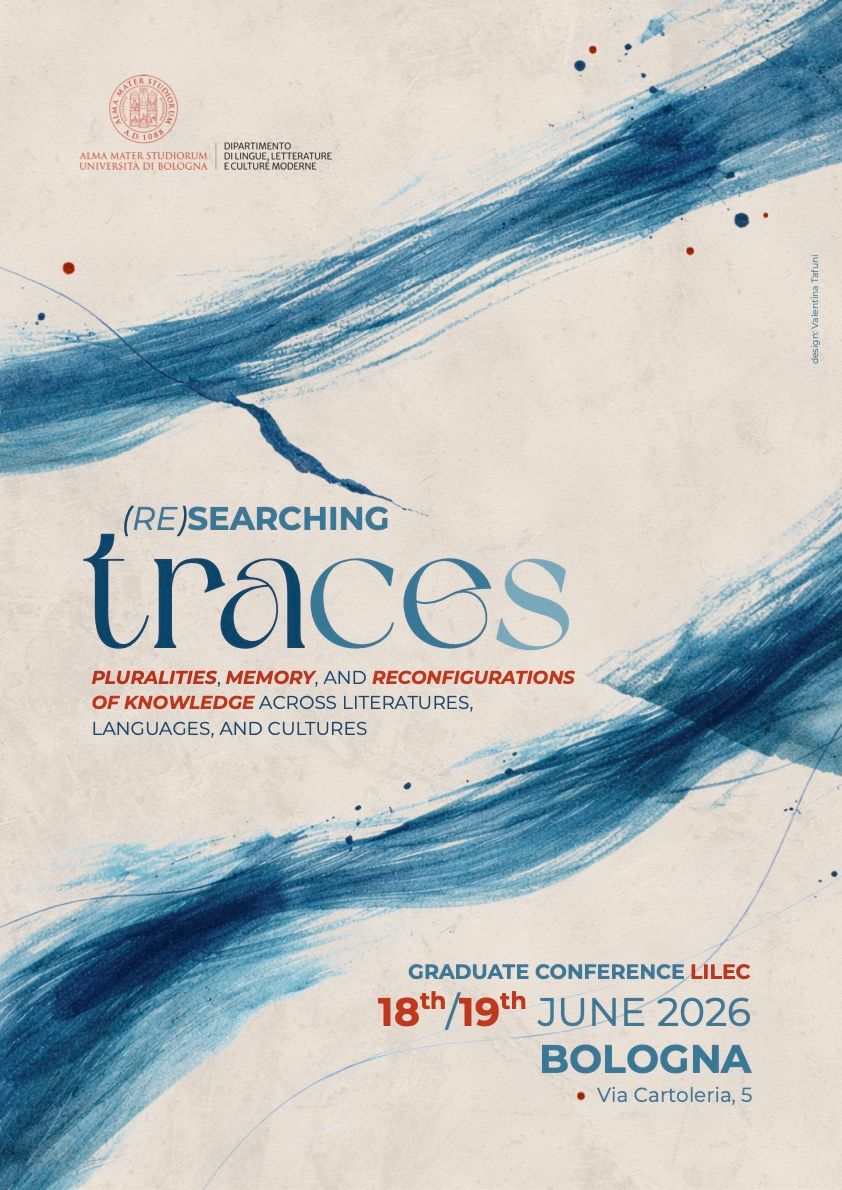
(Re)searching Traces. Pluralities, Memory, and Reconfigurations of Knowledge across Literatures, Languages, and Cultures (Bologne)
Graduate Conference 2026
Department of Modern Languages, Literatures and Cultures
18th – 19th June 2026
(Re)searching Traces
Pluralities, Memory, and Reconfigurations of Knowledge across Literatures, Languages, and Cultures
In the postmodern era, the human condition is marked by an increasing fragmentation and by the proliferation of information and perspectives that re-signify spaces of knowledge, languages, and forms of remembering, thus influencing identities and the capacity for self-determination of different subjectivities. Zones of contact/border and the fluid connections between different ways of remembering constitute “traces” of a form of knowledge that changes, becomes more complex, expands, and acquires new meanings depending on the way it is observed. Traces of the past, subject to continuous processes of re-signification and reconfiguration, consequently, influence the ways in which we come to know the world and interpret present-day society.
According to Derrida (1967), the “trace” is an expression of the différance and an element in a constant process of becoming. It constitutes a brisure, a rupture, that is, an a priori empty space that allows for the (re)articulation – like two sides of a fold –of past and present. Silent before being retrieved, traces – whether textual, iconographic, or linguistic – acquire meaning when they are observed from a specific critical perspective and placed within a configuration as parts of a complex and stratified whole, in which every narrative, like every form of knowledge, is always situated.
In the field of literary studies, postcolonial, decolonial, feminist, and gender-based methodological approaches have proposed alternative interpretations to the dominant way of thinking, and have proven to be useful critical tools not only for bringing to light still-silenced traces, but also for observing them through new lenses, positioning them in a dialogic, dynamic, and transformative way.
Despite their differences, these approaches have implemented strategies of re-signifying knowledge that has historically regulated archives, texts, languages, and literatures. The literary text is indeed seen as a true palimpsest where testimonies of filiations and literary legacies intertwine with, or are countered by, liminal voices of sociocultural contestation and resistance to dominant history, memory, and canon. In this context, the absence of traces is equally significant since the silences embedded in literary texts facilitate the production of collective and individual counter-memories and practices of rewriting, which contribute to filling those gaps often ignored by the dominant history.
Similarly, languages should be considered as dense networks of traces of culture, knowledge, history, and speakers’ identities, left in space or transmitted over time. Often ephemeral and stratified, linguistic (and more generally semiotic) traces constitute fragments that both reflect and contribute to the construction of the social and cultural reality in which they take shape and from which they are retrieved. Speakers themselves, in the realization of the communicative act, leave traces by constantly shaping, reworking, and redefining language, its systems, and its structures. From this perspective, language can be considered a dynamic fabric of traces in constant reconfiguration, which guide its variation along the diatopic, diastratic, diafasic and diamesic dimensions. Translation is no exception to this dynamic: far from being a neutral process, it inevitably incorporates traces of the translator’s subjectivity and cultural background, as well as the historical, political, and social context in which the translation is produced.
The 2026 Graduate Conference of the PhD Program in Modern Languages, Literatures, and Cultures: Diversity and Inclusion welcomes contributions that investigate the different meanings that traces can assume within literary, cultural, and linguistic studies. Contributions may be framed within the macro-sections outlined below:
- Practices of reconstructing knowledge: silences and voices in literary texts.
- Rewritings, intertextuality, and intermediality in literary works.
- Memories, counter-memories, and modes of remembering.
- Traces, production of space, and (new) literary geographies.
- The trace as a heuristic tool.
- Languages and variation as traces of speakers and repertoires.
- Traces of multilingualism: linguistic diversity, linguistic autobiographies, language contact, linguistic landscapes.
- Traces of past languages: diachronic linguistic analyses and history of languages.
- Traces in/of translation as both product and process.
—
Useful information
Presentations should be delivered in Italian or in English. The duration of each presentation should not exceed 15 minutes. Individual and group presentations are accepted.
The conference proceedings will be published in the Quaderni del dottorato after peer review.
Instructions for submitting proposals
Proposals for presentations must include an abstract (max. 300 words), a bibliography (max. 10 references) and a brief bio-bibliographical note (100/150 words) indicating the PhD student’s disciplinary field. Proposals should be sent to lilec.graduateconference@unibo.it by 30th March 2026.
Please name the file (.doc or .pdf format) as follows: “GC2026_FIRSTNAME_SURNAME”.