Fabula, la recherche en littérature (actu)

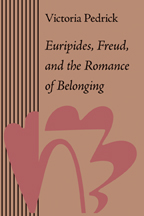
V. Pedrick, Euripides, Freud, and the Romance of Belonging

Parution livre

Information publiée le mardi 16 septembre 2008 par Sophie Rabau


_blank

Victoria Pedrick, Euripides, Freud, and the Romance of Belonging, The JohnHopkinsUniversity Press, 2007, 272p.

Isbn (ean13): 978-0-8018-8594-5


Description:

Freud's interpretation of the ancient legend of Oedipus—as formulated in Sophocles' tragic drama—is among the most widely known concepts of psychoanalysis. Euripides' Ion, however, presents a more complex version of the development of personal identity. Here, the discovery of family origins is a process in which parent and child both take part as distinct agents driven by their own impulses of violence and desire. Euripides, Freud, and the Romance of Belonging studies the construction of identity and the origins of the primal trauma in two texts, the Ion and Freud's case history of the Wolf Man. Victoria Pedrick challenges the conventional psychoanalytic theory of the development of the individual within the family, presenting instead a richer and more complex economy of exchange between the parent and the child. She provides a new perspective on Freud's appropriation of ancient texts and moves beyond the familiar reunion in Oedipus to the more nuanced scene of abandonment present in Ion. Her parallel investigation of these texts suggests that contemporary culture remains preoccupied by the problems of the past in the determination of identity. Pedrick's fresh perspectives on both texts as well as on their relationship to each other shed new light on two foundational moments in the intellectual development of the West: Greek tragedy and Freudian psychoanalysis.

L'auteur

Victoria Pedrick is an associate professor of classics at GeorgetownUniversity.


Url de référence :
http://www.press.jhu.edu/books/title_pages/9356.html


Derniers ouvrages parus :

Lexique nomade

A. Cousin de Ravel, Quignard, Maître de lecture. Lire, vivre, écrire

P. Engel, Les Lois de l'esprit. Julien Benda ou la raison

M. Crouzet, M. Myself ou La Vie de Stendhal (nouvelle version)

Laurence Brogniez (dir.), Écrits voyageurs. Les artistes et l'ailleurs

O. Biaggini, B. Milland-Bove (dir.), Miracles d'un autre genre  

Sévigné, Lettres de l'année 1671

A. Pope & J. Swift, Pensées sur différents sujets

H. Melville, Le Marchand de paratonnerres, suivi de La Véranda

Le Dit des Heiké

S. Kierkegaard, La Crise et une crise dans la vie d'une actrice

E. Maigret et M. Stefanelli (dir.), La Bande dessinée : une médiaculture

I. Raynauld, Lire et écrire un scénario - Le Scénario de film comme texte

J.-F. Bédia, Les Ecritures africaines face à la logique actuelle du comparatisme

Eusèbe de Césarée, Histoire ecclésiastique. Commentaire - Tome I : Études d'introduction

P. Engel, Les lois de l'esprit, Julien Benda ou la raison  

P. E. Fobah, Introduction à une poétique et une stylistique de la littérature africaine

M.-C. Alexandrine-Sinapah, Itinéraire d'un esclave-poète à Cuba - Juan Francisco Manzano (1797-1854) entre littérature et histoire

Cl. Launchbury, Music, Poetry, Propaganda. Constructing French Cultural Soundscapes at the BBC during the Second World War 

O. Rosenthal, Ils ne sont pour rien dans mes larmes

A. Alciato, Il libro degli Emblemi, secondo le edizioni del 1531 e del 1534

Marc Azéma, La Préhistoire du cinéma

J. Milly, Au seuil de l'image

I. Mons, Lou Andreas-Salomé. En toute liberté

N. Redouane, Lecture(s) de Rachid Mimouni

Fil d'informations RSS Fil d'information RSS   Fabula sur Facebook Fabula sur Facebook   Fabula sur Twitter Fabula sur Twitter