On peut lire un compte rendu de cet ouvrage dans la Bryn Mawr Classical Review
Vered Lev Kenaan,
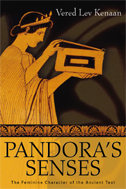
Pandora's Senses. The Feminine Character of the Ancient Text, The University of Wisconsin Press,coll. "Wisconsin Studies in Classics",
2008, 208p.
ISBN 978-0-299-22410-3.
Présentation de l'éditeur:
The notorious image of Pandora haunts mythology: a woman created as punishment for the crimes of man, she is the bearer of hope yet also responsible for the Earth's desolation. She binds together perpetuating dichotomies that underlie the most fundamental aspects of the Western canon: beauty and evil, body and soul, depth and superficiality, truth and lie. Speaking in multiplicity, Pandora emerges as the first sign of female complexity.
In this compelling study, Vered Lev Kenaan offers a radical revision of the Greek myth of the first woman. She argues that Pandora leaves a decisive mark on ancient poetics and shows that we can unravel the profound impact of Pandora's image once we recognize that Pandora embodies the very idea of the ancient literary text. Locating the myth of the first woman right at the heart of feminist interrogation of gender and textuality, Pandora's Senses moves beyond a feminist critique of masculine hegemony by challenging the reading of Pandora as a one-dimensional embodiment of the misogynist vision of the feminine. Uncovering Pandora as a textual principle operating outside of the feminine, Kenaan shows the centrality of this iconic figure among the poetics of such central genres as the cosmological and didactic epic, the Platonic dialogue, the love elegy, and the ancient novel. Pandora's Senses innovates our understanding of gender as a critical lens through which to view ancient literature.
Table des matières
Preface
Introduction
Chapter One: Pandora's Light
1. Pandora, Once Again
2. The Genealogy of Pandora
3. Misogynist Responses to Pandora
4. Pandora's Wonder
a. Pandora as the Theogony's center
b. Feminine beauty and the beauty of the universe
c. Thauma Idesthai
d. Pandora vs. Typhoeus
e. Pandora's bright light vs. Zeus's blinding lightning
f. Pandora's enlightenment and Hesiod's initiation
Chapter Two: Pandora and the Myth of Otherness
1. From Mount Helicon to a Poetics of Otherness
2. The Fantasy of Symbiosis between Men and Gods
3. Ambiguities of Identity: The Case of Brothers
4. The Loss of Sameness and the Birth of Eros
5. The Didactic Imperative: Learn the Other
Chapter Three: The Socratic Pandora
1. Woman is the Ideal Listener
2. The Naked Truth and the Adorned Lie
a. The winter maiden
b. The dressed woman
3. The Seductions of Pandora
4. Socrates and Theodote
5. Socrates and Pandora
a. Socrates's body
b. Socrates's beauty
c. Socrates's eros
Chapter Four: Pandora's Voice and the Emergence of Ovid's Poetic Persona
1. Pandora's Voice
a. Clytemnestra's Kratos
b. Silencing Penelope
c. Pandora's comic voice
2. From the Effeminate Elegy to the Feminine Text
3. The Erotodidactic Persona
4. Sappho's Lasciviousness
5. The Lascivious Text
a. Ovidius Utroque Lascivior
b. Musa Proterva mea est
Chapter Five: Feminine Subjectivity and the Self-Contradicting Text
1.The Ars and the Remedia: meta-discourse, language games and the problem of sincerity
2.The Palinodic Structure
3. Palinode and Narrative
4. Pandora's Lie
5. A Girl's Rape and the Birth of Feminine Subjectivity
Chapter Six: Pandora's Tears
1. Feminine Weaving: Text, Textile, Body, Pain
2. Helen's Web
3. Listening as a Woman: Penelope's Tears
4. Odysseus Weeps as a Woman
5. Xanthippe's Tears
Epilogue
Notes
Bibliography
Index