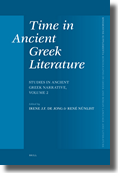
Time in Ancient Greek Literature
Studies in AncientGreek narrative, volume 2
Edited byIrene J.F. de Jong and René Nünlist
Brill, coll. Mnemosyne, Supplements n°291
2007
Isbn (ean13): 978 90 04 16506 9
ISSN:0169-8958
542 pp, 139€
Présentationde l'éditeur
This is the second volumein a series of volumes which together will provide an entirely new history ofancient Greek (narrative) literature. Its organization is formal rather thanbiographical. It traces the history of central narrative devices, such as thenarrator and his narratees,time, focalization, characterization, and space. Itoffers not only analyses of the handling of such a device by individualauthors, but also a larger historical perspective on the manner in which itchanges over time and is put to different uses by different authors indifferent genres. The present volume deals with time: changes in the order ofevents (analepsis versus prolepsis), the speed of narration (events may berecounted scenically or in the form of a summary), and frequency (events may berecounted once, repeatedly, or not at all).
Irene J.F. de Jong,Ph.D. (1987) in Ancient Greek Literature, University of Amsterdam, isProfessor of Greek at the University of Amsterdam. She specializes inthe narratological analysis of ancient Greek texts; her publicationsinclude Narrators and Focalizers. The Presentation of the Story in the Iliad (1987, repr. 2004) and A Narratological commentary on the Odyssey (2001).
René Nünlist, Ph.D. (1996) in Classics, University of Basel, is Associate Professor of Classics at Brown University. Publications include: Poetologische Bildersprache in der frühgriechischen Dichtung (1998), The Ancient Critic at Work: Terms and Concepts of Literary Criticism in Greek Scholia (forthcom.).
Sommaire:
Homer / I.J.F. de Jong -- Hesiod / R. Nunlist -- Thehomeric hymns / R. Nunlist -- Apollonius of Rhodes / J.J.H. Klooster --Callimachus / M.A. Harder -- Theocritus / J.J.H. Klooster -- Herodotus/ T. Rood -- Thucydides / T. Rood -- Xenophon / T. Rood -- Polybius /T. Rood -- Arrian / T. Hidber -- Herodian / T. Hidber -- Josephus /J.W. van Henten & L. Huitink -- Pindar and Bacchylides / R. Nunlist-- Aeschylus / J. Barrett -- Sophocles / I.J.F. de Jong -- Euripides /M.A. Lloyd -- Aristophanes / A.M. Bowie -- Antiphon / M.J. Edwards --Lysias / M.J. Edwards -- Demosthenes / M.J.Edwards -- Plato /K.A.Morgan -- Xenophon / K.A. Morgan -- Xenophon / M. Beck -- Plutarch/ M. Beck -- Philostratus / T.J.G. Whitmarsh -- Chariton / J.R. Morgan-- Xenophon of Ephesus / J. Morgan -- Longus / J.R. Morgan --Heliodorus / J.R. Morgan -- Time in ancient Greek literature / I.J.F.de Jong & R. Nunlist.
***
On pourra lire un compte rendu de cet ouvrage par Denis Feeney, sur le site de la Bryn Mawr Classical Review, ainsi qu'une recension du premier volume des Studies in Ancient Greek Literature: Narrators, Narratees, and Narratives, par Ruth Scodel (BMCR 2005.07.48)