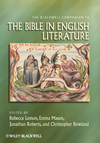
The Blackwell Companion to the Bible in English Literature, Wiley-Blackwell, 2009, 720 p.
Sous la direction de Rebecca Lemon, Emma Mason, Jonathan Roberts & Christopher Rowland.
- ISBN: 978-1-4051-3160-5 Hardcover
- £95.00 / €114.00
This Companion explores the Bible's role and influence on individualwriters, whilst tracing the key developments of Biblical themes andliterary theory through the ages.
- An ambitious overview of the Bible's role and influence on Englishliterature - as arguably the most powerful work of literature inhistory - from the medieval period up through the 20th century
- Includes introductory sections to each period givingbackground information about the Bible as a source text in Englishliterature, and placing writers in their historical context
- Draws on examples from medieval, early-modern, eighteenth-century and Romantic, Victorian, and Modernist literature
- Includes many ‘secular' or ‘anti-clerical' writers alongsidetheir ‘Christian' contemporaries, revealing how the Bible's text shiftsand changes in the writing of each author who reads and studies it
Rebecca Lemon is an associate professor of English literature at the University of Southern California. She is the author of Treason by Words: Literature, Law, and Rebellion in Shakespeare's England (2006), as well as articles on Mary Wroth and Petrarchism, Shakespeare and Agamben, and Hayward and censorship.
Emma Mason is a senior lecturer in English at the University of Warwick. She is the author of Women Poet's of the Nineteenth Century (2006), Nineteenth Century Religion and Literature: An Introduction (with Mark Knight, 2006), and The Cambridge Introduction to Wordsworth (2009).
Jonathan Roberts is a lecturer in English at the University of Liverpool. He is the author of William Blake's Poetry (2007), The Bible for Sinners (with Christopher Rowland, 2008), the forthcoming Blake. Wordsworth. Religion. (2009) and is co-editing the forthcoming Oxford Companion to the Reception History of the Bible (2010).
Christopher Rowland is Dean Ireland's Professor of Holy Exegesisat the University of Oxford. He has written on radical Christianwritings including those of Gerrard Winstanley and William Blake andthe Bible. He is the author of a number of books, including The Nature of New Testament Theology (2006), Revelation Through the Centuries (with Judith Kovacs, 2003), and Radical Christian Writings: A Reader(with Andrew Bradstock, 2002), all published by Wiley-Blackwell.Together with John Sawyer and Judith Kovacs he also edits the BlackwellBible Commentary series.
Sommaire:
Part I: Introduction.
1. Editors' Introduction, Rebecca Lemon, Emma Mason, Jonathan Roberts, and Christopher Rowland.
2. The Literature of the Bible, Christopher Rowland.
3. Biblical Hermeneutics and Literary Theory, David Jasper.
Part II: Medieval.
4. Medieval Literature, Daniel Anlezark.
5. The Bible in Old English Poetry, Catherine A. M. Clarke.
6. The Medieval Religious Lyric, Douglas Gray.
7. The Middle English Mystics, Annie Sutherland.
8. The Pearl-Poet, Helen Barr.
9. The Bible in William Langland's Piers the Plowman, Sister Mary Clemente Davlin, OP.
10. Chaucer and the Bible, Christiania Whitehead.
Part III: Early Modern.
11. The Bible in Early Modern Literature: Introduction, Roger Pooley.
12. Early Modern Women and the Bible, Elizabeth Clarke.
13. Early Modern Religious Prose, Julie Maxwell.
14. Spenser and the Bible, Carol V. Kaske.
15. The Countess of Pembroke and the Book of Psalms, Rivkah Zim.
16. Shakespeare and the Bible, Hannibal Hamlin.
17. Donne and the Bible, Jeanne Shami.
18. George Herbert and the Bible, John Drury.
19. John Milton, Michael Lieb.
20. Bunyan and the Bible, Andrew Bradstock.
21. John Dryden, Gerard Reedy, SJ.
Part IV: Eighteenth Century and Romantic.
22. The Bible in the Eighteenth Century, Stephen Prickett.
23. Eighteenth-Century Hymn Writers, J. R. Watson.
24. Daniel Defoe, Valentine Cunningham.
25. Swift and The Bible, Michael F. Suarez, SJ.
26. William Blake and the Bible, Jonathan Roberts and Christopher Rowland.
27. Women Romantic Poets and the Bible, Penny Bradshaw.
28. Wordsworth and the Bible, Deeanne Westbrook.
29. Coleridge and the Bible, Graham Davidson.
30. Jane Austen and the Bible, Michael Giffin.
31. Byron and the Bible, Wolf Z. Hirst.
32. Shelley and the Bible, Bernard Beatty.
Part V: Victorian.
33. The Victorian Period, Elisabeth Jay.
34. The Brownings and the Bible, Kevin Mills.
35. Tennyson and the Bible, Kirstie Blair.
36. The Brontës and the Bible, Marianne Thormählen.
37. Ruskin and the Bible, Dinah Birch.
38. George Eliot and the Bible, Charles LaPorte.
39. Christina Rossetti and the Bible, Elizabeth Ludlow.
40. Hopkins and the Bible, Paul S. Fiddes.
41. Sensation Fiction and the Bible, Mark Knight.
42. Decadence and the Bible, Andrew Tate.
Part VI: Modernism.
43. The Bible in Modern Literature, Ward Blanton.
44. W. B. Yeats and the Bible, Ed Larrissy.
45. Virginia Woolf and the Bible, Douglas L. Howard.
46. James Joyce and the Bible, William Franke.
47. D. H. Lawrence, T. R. Wright.
48. T. S. Eliot and the Bible, David Fuller.
49. The Bible and the Great War Poets, Jane Potter.