Fabula, la recherche en littérature (actu)

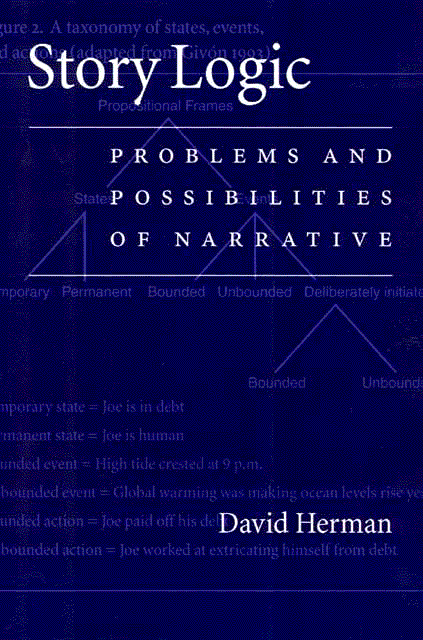
Story Logic. Problems and Possibilities of Narrative

Parution livre

Information publiée le jeudi 11 avril 2002 par René Audet


_blank

David Herman, Story Logic. Problems and Possibilities of Narrative, University of Nebraska Press, 2002, 477 p. (Frontiers of Narrative series)

ISBN: 0-8032-2399-4

Description de l'éditeur:

Featuring a major synthesis and critique of interdisciplinary narrative theory, Story Logic marks a watershed moment in the study of narrative. David Herman argues that narrative is simultaneously a cognitive style, a discourse genre, and a resource for writing. Because stories are strategies that help humans make sense of their world, narratives not only have a logic but also are a logic in their own right, providing an irreplaceable resource for structuring and comprehending experience. Story Logic brings together and pointedly examines key concepts of narrative in literary criticism, linguistics, and cognitive science, supplementing them with a battery of additional concepts that enable many different kinds of narratives to be analyzed and understood. By thoroughly tracing and synthesizing the development of different strands of narrative theory and provocatively critiquing what narratives are and how they work, Story Logic provides a powerful interpretive tool kit that broadens the applicability of narrative theory to more complex forms of stories, however and wherever they appear. Story Logic offers a fresh and incisive way to appreciate more fully the power and significance of narratives. David Herman is a professor of English at North Carolina State University and an adjunct professor of linguistics at Duke University. He is the author of Universal Grammar and Narrative Form and the editor of Narratologies: New Perspectives on Narrative Analysis.


Derniers ouvrages parus :

L. Dupuy, Géographies. le territoire et ses paradoxes

H. Machinal (dir.), Le Savant fou

P. Maurus et P. Popovic (dir.), Actualité de la sociocritique

M. Serra, Italo Svevo ou l'Antivie

E. Buch, N. Donin & L. Feneyrou (dir.), Du politique en analyse musicale

A. Compagnon, L'Été avec Montaigne

B. Binoche, Les trois sources des philosophies de l’histoire (1764-1798)

A. Rey, Des pensées et des mots

A. Crasson (dir.), Edmond Jabès : l’exil en partage

M. Moser-Verrey, Isabelle de Charrière : salonnière virtuelle. Un itinéraire d'écriture au XVIIIe s.

S.-P.  Hardy, Mes Loisirs, ou Journal d'événements tels qu'ils parviennent à ma connaissance (1753-1789), vol. 4

Y. Citton et L. Dumasy, Le Moment idéologique - Entre émergence de la littérature et constitution des sciences de l'homme

A. Richard, L'Autofiction et les femmes - Un chemin vers l'altruisme ?

D. Cahen, À livre ouvert

M. Lo Nostro, La dictionnairique bilingue. Analyse et suggestions

M.-Chr. Pioffet (dir.), Dictionnaire analytique des toponymes imaginaires dans la littérature narrative de langue française (1605-1711)

J.-Cl. Vuillemin, Épistémè baroque. Le mot et la chose

S. Harvey, Entre littérature galante et objet précieux. Étude et édition critique des Divers portraits de Mademoiselle de Montpensier (1659)

M. Del Fiol, Lorand Gaspar, Approches de l'immanence

D. Melnkiené, Le dictionnaire bilingue. Un miroir déformant ?

M. Centrella, Le vocabulaire informatique. De la norme à l'usage

R. Poignault (dir.), Présence de la danse dans l'Antiquité. Présence de l'Antiquité dans la danse

Michael Sheringham, Traversées du quotidien

M. Augé, L'anthropologie et le monde global

R. Calasso, La littérature et les dieux (rééd.)

Fil d'informations RSS Fil d'information RSS   Fabula sur Facebook Fabula sur Facebook   Fabula sur Twitter Fabula sur Twitter