Fabula, la recherche en littérature (actu)

S. West, The Performative Voice in the Dramatic Works of Samuel Beckett

Parution livre avec compte rendu à paraître prochainement dans Acta

Information publiée le lundi 6 septembre 2010 par Marion Moreau


_blank

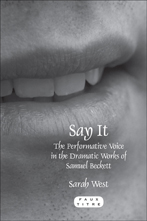
Sarah West, Say it. The Performative Voice in the Dramatic Works of Samuel Beckett.

New York : Rodopi, coll. "Faux Titre", 2010.

277 p.

Prix : 55EUR.

EAN : 9789042030787.

Présentation de l'éditeur :

Central to Samuel Beckett’s literature is a wilful voice which insists on speaking and being heard. Beckett described it as “a truly exterior voice”, and in the plays he separates voice from the body and turns it into an audible character. Previous critical studies have explored the enigma of this voice, its identity, source and location, but little attention has been given to the voice as protagonist. This volume traces the genesis of the performative voice in the early prose and charts its trajectory throughout the dramatic oeuvre in a readable narrative which generates fresh insights into some of Beckett’s most remarkable and impenetrable plays. It examines the use of embodied and acousmatic – ‘out of body’ – voices in the different media of theatre, radio and television; the treatment of voice in relation to music, image and movement; and the ‘shifting threshold’ between the written and spoken word. The analysis comprises a detailed study of dramatic speech and technical aspects of sound reproduction, making it relevant for all scholars and students with an interest in textual and performance issues in Beckett’s drama.


Url de référence :
http://www.rodopi.nl/functions/search.asp?BookId=FAUX+352


Derniers ouvrages parus :

R. Corona, Mots de l'enfermement - Clôtures et silences : lexique et rhétorique de la douleur du néant

J. Hillion, Shakespeare et son double - Les Sonnets de Shakespeare à la lumière de la théorie mimétique de René Girard

Alison Boulanger et Jessica Wilker, (éd.), La posture de l'herméneute. Essais sur l'interprétation dans la littérature

Nadia R. Altschul : Geographies of Philological Knowledge. Postcoloniality and the Transatlantic National Epic

A. Matei, Jean Echenoz et la distance intérieure

P. Citti, Taine, philosophe du récit

F. Parisot (dir.), Alejo Carpentier à l'aube du XXIème siècle

Chr. Chaulet Achour (dir.), À l'aube des Mille et Une Nuits. Lectures comparatistes

M. Méricam-Bourdet, Voltaire et l’écriture de l’histoire: un enjeu politique

J.-P. Cléro, E. Faye (dir.), Descartes, des principes aux phénomènes

D. Bellos, Le Poisson et le bananier. L'histoire fabuleuse de la traduction

J. Rancière, La Leçon d'Althusser

E. Zola, Mes haines (GF-Flammarion)

E. Zola, Correspondance (GF-Flammarion)

J. Caradonna, The Enlightenment in Practice: Academic Prize Contests and Intellectual Culture in France, 1670–1794

R. Le Menthéour, La Manufacture de maladies. La dissidence hygiénique de J.-J. Rousseau

C. Hammann, Déplaire au public : le cas Rousseau

A. Biancofiore, Pasolini - Devenir d'une création

N. Sabri, La Kahéna - Un mythe à l'image du Maghreb

N. Aubert, Christian Dotremont. La Conquête du monde par l'image

R. Faure et  C. Cusset, Silves grecques 2012-2013 : Apollonios de Rhodes, Argonautiques III ; Xénophon, le Banquet et Apologie de Socrate

B. Joly, Descartes et la chimie

A. Dominguez Leiva, S Hubier, F. Toudoire-Surlarpierre, Le comparatisme, un univers en 3D?

L. Boltanski, Enigmes et complots - Une enquête à propos d'enquêtes

P.-M. de Biasi, Génétique des textes

Fil d'informations RSS Fil d'information RSS   Fabula sur Facebook Fabula sur Facebook   Fabula sur Twitter Fabula sur Twitter