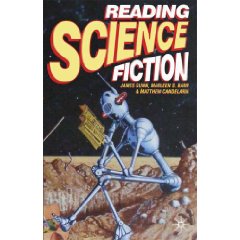
GUNN, James, Marleen S. BARR et Matthew CANDELARIA (dir.), Reading Science Fiction, New York, Palgrave Macmillan, 2008, 256 p.
ISBN 0-230-52718-3
RÉSUMÉ
ScienceFiction is illuminated by world class scholars and fiction writers, whointroduce the history, concepts and contexts necessary to understandingthe genre. Their groundbreaking approach provides insights intotoday's SF world and makes learning how to read Science Fiction anexciting collaborative process for teachers and students.
TABLE DES MATIÈRES
Introduction
Part I: Mapping Science Fiction
Editor's Introduction
Defining Science Fiction Eric S. Rabkin
What is Science Fiction - and How it Grew: H. Bruce Franklin
Narrative Strategies in Science Fiction: Brian Stableford
There is No Such Thing as Science Fiction: Mark Bould and Sherryl Vint
Part II: Reading Science Fiction in the Classroom
Editor's Introduction
The Protocols of Reading SF: James Gunn
Reading Joanna Russ in Context: Science, Utopia and Postmodernity: Jeanne Cortiel
Reading Science Fiction's Interdisciplinary Conversation with Science and Technology Studies: Lisa Yaszek and Doug Davis
Part III: Science Fiction and Popular Culture
Editor's Introduction
Video Games and Science Fiction: Orson Scott Card
The Feedback Loop: Science Fiction and Television: Michael Cassutt
Film and Science Fiction: George Zebrowski
Computers and Science Fiction: Brooks Landon
Part IV: Theoretical Approaches
Editor's Introduction
Gender is a Problem That Can Be Solved: Science Fiction and Gender Theory: Jane Donawerth
Postcolonial Approaches to Reading Science Fiction: Matthew Candelaria
International Science Fiction: James Gunn
Marxism and Science Fiction: Carl Freedman
Part V: Science Fiction and Diverse Disciplines
Editor's Introduction
Science Fiction and Neurobiology: Joe Miller
Physics and Science Fiction: Gregory Benford
Science Fiction and Biology: Greg Bear
Science Fiction and the Evolution of Technology: Paul Levinson
Cyberspace and Science Fiction: Bruce Sterling
Bibliography
Index
BIOGRAPHIE
Ames Gunn is Emeritus Professor of English atK.U.and has published more than a dozen novels and half a dozencollections of stories, and has edited more than a dozen and a halfbooks. His best-known novels are The Immortals, The Dreamers, The Listeners, Kampus and The Joy Makers. The Immortals was filmed as The Immortal and became a TV series. His academic publications include Alternate Worlds: The Illustrated History of Science Fiction, The New Encyclopedia of Science Fiction, the six-volume anthology The Road to Science Fiction, The Science of Science-Fiction Writing, Speculations on Speculation: Theories of Science Fiction and Inside Science Fiction.
Marleen S Barr is known for her pioneering work in feminist science fiction andteaches in the Department of Communication and Media Studies at FordhamUniversity. She has won the Science Fiction Research AssociationPilgrim Award for lifetime achievement in science fiction criticism.Barr is the author of Alien to Feminity: Speculative Fiction and Feminist Theory, Lost in Space: Probing Feminist Science Fiction and Beyond, Feminist Fabulation: Space/Postmodern Fiction and Genre Fission: A New Discouse Practice for Cultural Studies. Barr has edited many anthologies and co-edited the special science fiction issue of PMLA.
Matthew Candelaria received his PhD from the University of Kansas and haspublished articles on science fiction. He is recipient of the 2003Golden Quill Award from the L. Ron Hubbard's Writers of the FutureContest and co-editor of Speculations on Speculation: Theories of Science Fiction.