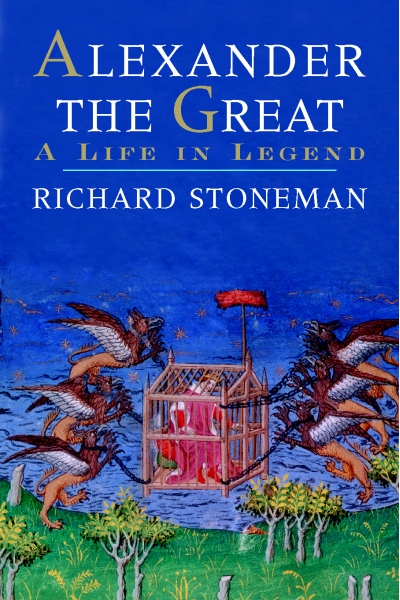
Richard Stoneman, Alexander the Great: A Life in Legend, New Haven, CT/London: Yale University Press, 2008, xvii-314p.
Isbn (ean13): 978-0-300-11203-0
Recension par Dawn L. Gilley (University of Missouri-Columbia) dans Bryn Mawr Classical Review 2008.09.19:
http://ccat.sas.upenn.edu/bmcr/2008/2008-09-19.html
Présentation de l'éditeur:
Alexander theGreat (356-323 B.C.) precipitated immense historical change in theMediterranean and Near Eastern worlds. But the resonance his legendachieved over the next two millennia stretched even farther—acrossforeign cultures, religious traditions, and distant nations.
Thisengaging and handsomely illustrated book for the first time gatherstogether hundreds of the colorful Alexander legends that have been toldand retold around the globe. Richard Stoneman, a foremost expert on theAlexander myths, introduces us first to the historical Alexander andthen to the Alexander of legend, an unparalleled mythic icon who cameto represent the heroic ideal in cultures from Egypt to Iceland, fromBritain to Malaya.
Alexandercame to embody the concerns of Hellenistic man; he fueled Roman ideason tyranny and kingship; he was a talisman for fourth-century pagansand a hero of chivalry in the early Middle Ages. He appears in Jewish,Christian, and Islamic writings, frequently as a prophet of God.Whether battling winged foxes or meeting with the Amazons, descendingto the underworld or inventing the world's first diving bell, Alexanderinspired as a hero, even a god. Stoneman traces Alexander's influencein ancient literature and folklore and in later literatures of east andwest. His book provides the definitive account of the legends ofAlexander the Great—a powerful leader in life and an even more powerfulfigure in the history of literature and ideas.
RichardStoneman is Honorary Fellow, University of Exeter, and a director ofWestminster Classic Tours. He has written extensively in the field ofGreek history. He lives in Devon, England.
Sommaire:
PrefaceList of AbbreviationsList of IllustrationsIntroduction1. Nativity: Egyptian origins (356 BC)2. Golden Vines, Golden Bowls and temples of Fire: the Persian Versions3. Cities of Alexander: Jews and Arabs adopt the hero4. The Marvels of India (329-326 BC)5. 'How Much Land Does A Man Need?' Alexander's encounter with the Brahmans (326 BC)6. Alexander as Inventor and Sage7. Alexander among Women8. The Search for Immortality9. The Unclean Nations and the End of Time10. Death in Babylon (323 BC)11. Afterlife I: The Medieval Alexander12. Afterlife II: Alexander the GreekEpilogueNotesBibliographyIndex