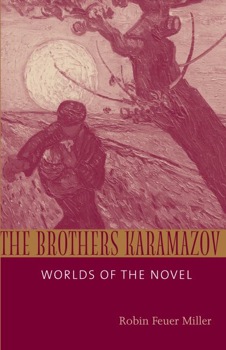
Robin Feuer Miller, The Brothers Karamazov. Worlds of the Novel, Yale University Press, 2008, 192 p.
- ISBN: 9780300125627
- ISBN-10: 030012562
Lire un extrait.
Présentation de l'éditeur:
Fyodor Dostoevsky completed his final novel— The Brothers Karamazov—in 1880. A work of universal appeal and significance, his exploration of good and evil immediately gained an international readership and today “remains harrowingly alive in the face of our present day worries, paradoxes, and joys,” observes Dostoevsky scholar Robin Feuer Miller. In this engaging and original book, she guides us through the complexities of Dostoevsky's masterpiece, offering keen insights and a celebration of the author's unparalleled powers of imagination.
Miller's critical companion to The Brothers Karamazov explores the novel's structure, themes, characters, and artistic strategies while illuminating its myriad philosophical and narrative riddles. She discusses the historical significance of the book and its initial reception, and in a new preface discusses the latest scholarship on Dostoevsky and the novel that crowned his career.
Robin Feuer Miller is Edytha Macy Gross Professor of Humanities; professor of Russian and comparative literature; and chair, Department of German, Russian and Asian Languages and Literatures, Brandeis University. Her most recent book is Dostoevsky's Unfinished Journey, published by Yale University Press. She lives in Newton, MA.
Consulter le sommaire.