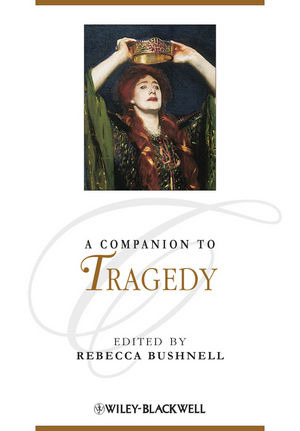
A Companion to Tragedy, Wiley-Blackwell, coll. "Blackwell Companions", 2009 (2005), 568 p.
Sous la direction de Rebecca Bushnell
- ISBN: 978-1-4051-0735-8 (Hardcover 2005)
- ISBN: 978-1-4051-9246-0 (Paperback 2009)
- £24.99 / €30.0
A Companion to Tragedy is an essential resource for anyone interested in exploring the role of tragedy in Western history and culture.
- Tells the story of the historical development of tragedy from classical Greece to modernity
- Features 28 essays by renowned scholars from multipledisciplines, including classics, English, drama, anthropology andphilosophy
- Broad in its scope and ambition, it considers interpretations of tragedy through religion, philosophy and history
- Offers a fresh assessment of Ancient Greek tragedy anddemonstrates how the practice of reading tragedy has changed radicallyin the past two decades
Rebecca Bushnell is Dean of the School of Arts and Sciences andProfessor of English at the University of Pennsylvania. Her previouspublications include Prophesying Tragedy: Sign and Voice in Sophocles' Theban Plays (1988), Tragedies of Tyrants: Political Thought and Theater in the English Renaissance (1990), A Culture of Teaching: Early Modern Humanism in Theory and Practice (1996), Tragedy: A Short Introduction, and Green Desire: Imagining Early Modern English Gardens (2003).
Sommaire:
Introduction: Rebecca Bushnell (University of Pennsylvania).
Tragic Thought.
Part One: Tragedy and the Gods.
1.Tragedy and Ritual: Christiane Sorvinou-Inwood (author).
2.Tragedy and Dionysus: Richard Seaford (University of Exeter).
Part Two: Tragedy, Philosophy, and Psychoanalysis.
3. Aristotle's Poetics: A Defense of Tragic Fiction: Kathy Eden (Columbia University).
4. The Greatness and Limits of Hegel's Theory of Tragedy: Mark W. Roche (University of Notre Dame).
5. Nietzsche and Tragedy: James Porter (University of Michigan).
6. Tragedy and Psychoanalysis: Freud and Lacan: Julia Reinhard Lupton (University of California, Irvine).
Part Three: Tragedy and History.
7. Tragedy and City: Deborah Boedeker (Brown University) and Kurt Raaflaub (Brown University).
8. Tragedy and Materialist Thought: Hugh Grady (Arcadia University).
9. Tragedy and Feminism: Victoria Wohl (Ohio State University).
Tragedy in History.
Part Four: Tragedy in Antiquity.
10. Tragedy and Myth: Alan Sommerstein (University of Nottingham).
11. Tragedy and Epic: Ruth Scodel (University of Michigan).
12. Tragedy in Performance: Michael Halleran (University of Washington).
13.The Tragic Choral Group: Dramatic Role and Social Functions: ClaudeCalame (Ecole de Hautes Etudes en Sciences Sociales) translated by DanEdelstein.
14. Women in Greek Tragedy: Sheila Murnahagn (University of Pennsylvania).
15. Aristophanes, Old Comedy and Greek Tragedy: Ralph Rosen (University of Pennsylvania).
16. Roman Tragedy: Alessandro Schiesaro (King's College, University of London).
Part Five: Renaissance and Baroque Tragedy.
17.The Fall of Princes: The Classical and Medieval Roots of EnglishRenaissance Tragedy: Rebecca Bushnell (University of Pennsylvania).
18. Something is Rotten: English Renaissance Tragedies of State: Matthew H. Wikander (University of Toledo).
19. English Revenge Tragedy: Michael Neill (University of Auckland).
20. Spanish Golden Age Tragedy: Cervantes to Calderon: Margaret R. Greer (Duke University).
Part Six: Neoclassical and Romantic Tragedy.
21. Neoclassical Dramatic Theory in Seventeenth-Century France: Richard E. Goodkin (University of Wisconsin-Madison).
22. French Neoclassical Tragedy: Corneille/Racine: Mitchell Greenberg (Cornell University).
23.Romantic Tragic Drama and its Eighteenth-Century Precursors: RemakingBritish Tragedy: Jeffrey N. Cox (University of Colorado at Boulder).
24. German Classical Tragedy: Lessing, Goethe, Schiller, Kleist, and Büchner: Simon Richter (University of Pennsylvania).
25. French Romantic Tragedy: Barbara T. Cooper (University of New Hampshire).
Part Seven: Tragedy and Modernity.
26. Modern Theater and the Tragic in Europe: Gail Finney (Univeristy of California, Davis).
27. Tragedy in the Modern American Theatre: Brenda Murphy (University of Connecticut).
28. Using Tragedy against its Makers: Some African and Caribbean Instances: Timothy J. Reiss (New York University).