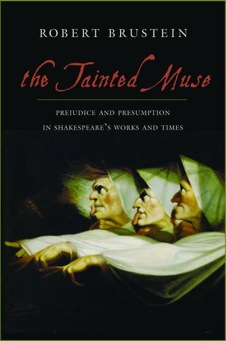
Robert Brustein, The Tainted Muse. Prejudice and Presumption in Shakespeare and His Time, Yale University Press, 2009, 288 p.,
- ISBN: 9780300115765
- ISBN-10: 0300115768
Présentation de l'éditeur:
This book is a masterful and engagingexploration of both Shakespeare's works and his age. Concentrating onsix recurring prejudices in Shakespeare's plays—such as misogyny,elitism, distrust of effeminacy, and racism—Robert Brustein examineshow Shakespeare and his contemporaries treated them. More than simply athematic study, the book reveals a playwright constantly exploiting andexploring his own personal stances. These prejudices, Brustein finds,are not unchanging; over time they vary in intensity andtreatment. Shakespeare is an artist who invariably reflects thepredilections of his age and yet almost always manages to transcendthem.
Brusteinconsiders the whole of Shakespeare's plays, from the early histories tothe later romances, though he gives special attention to Hamlet, King Lear, Othello, and The Tempest.Drawing comparisons to plays by Marlowe, Middleton, and Marston,Brustein investigates how Shakespeare's contemporaries were preoccupiedwith similar themes and how these different artists treated the currentprejudices in their own ways. Rather than confining Shakespeare to hisage, this book has the wonderful quality of illuminating both what heshared with his time and what is unique about his approach.
RobertBrustein was founding director of the Yale Repertory Theatre and of theAmerican Repertory Theatre and was drama critic for the New Republic for almost fifty years. He is the author of six plays, eleven adaptations, and sixteen books, including The Theater of Revolt and Millennial Stages: Essays and Reviews, 2001–2005, published by Yale University Press. He lives in Cambridge, MA.