Fabula, la recherche en littérature (actu)

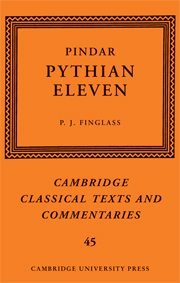
Pindar, Pythian Eleven

Parution livre

Information publiée le jeudi 21 août 2008 par Bérenger Boulay


_blank


Pindar, Pythian Eleven, édité par P. J. Finglass (University of Nottingham), Cambridge, Cambridge University Press, coll. "Cambridge Classical Texts and Commentaries" n° 45, décembre 2007, ix- 158p.

Isbn (ean13): 978-0-521-88481-5

Recension par William Slater (McMaster University) dans Bryn Mawr Classical Review: 2008.08.37

Présentation de l'éditeur:


Pindar's Pythian Eleven is a miniature masterpiece: a poem praising a young athlete which presents a vivid and important account of the Agamemnon legend. Yet it contains so many difficulties (of text, metre, dating and interpretation) that even Wilamowitz regarded it as one of Pindar's most obscure poems. This new edition (the first full-scale treatment that the poem has ever received) provides answers to the problems that have prevented proper appreciation of the work. In addition to the full introduction and commentary, the book also has a new text based on re-examination of the manuscripts, detailed metrical discussion, and a translation.

• First full-scale treatment which this poem has ever received • Offers a completely new text and critical apparatus based on re-examination of the manuscripts • Provides a full commentary and translation

Introduction au format PDF (184KB)

Sommaire:

Preface; Introduction; Metrical analysis; Testimonia; Synopsis of readings; Text, translation and apparatus; Commentary.

Table des matières au format PDF (88KB)

Index au format PDF (136KB)


Url de référence :
http://www.cambridge.org/uk/catalogue/catalogue.asp?isbn=9780521884815


Derniers ouvrages parus :

Lexique nomade

A. Cousin de Ravel, Quignard, Maître de lecture. Lire, vivre, écrire

P. Engel, Les Lois de l'esprit. Julien Benda ou la raison

M. Crouzet, M. Myself ou La Vie de Stendhal (nouvelle version)

Laurence Brogniez (dir.), Écrits voyageurs. Les artistes et l'ailleurs

O. Biaggini, B. Milland-Bove (dir.), Miracles d'un autre genre  

Sévigné, Lettres de l'année 1671

A. Pope & J. Swift, Pensées sur différents sujets

H. Melville, Le Marchand de paratonnerres, suivi de La Véranda

Le Dit des Heiké

S. Kierkegaard, La Crise et une crise dans la vie d'une actrice

E. Maigret et M. Stefanelli (dir.), La Bande dessinée : une médiaculture

I. Raynauld, Lire et écrire un scénario - Le Scénario de film comme texte

J.-F. Bédia, Les Ecritures africaines face à la logique actuelle du comparatisme

Eusèbe de Césarée, Histoire ecclésiastique. Commentaire - Tome I : Études d'introduction

P. Engel, Les lois de l'esprit, Julien Benda ou la raison  

P. E. Fobah, Introduction à une poétique et une stylistique de la littérature africaine

M.-C. Alexandrine-Sinapah, Itinéraire d'un esclave-poète à Cuba - Juan Francisco Manzano (1797-1854) entre littérature et histoire

Cl. Launchbury, Music, Poetry, Propaganda. Constructing French Cultural Soundscapes at the BBC during the Second World War 

O. Rosenthal, Ils ne sont pour rien dans mes larmes

A. Alciato, Il libro degli Emblemi, secondo le edizioni del 1531 e del 1534

Marc Azéma, La Préhistoire du cinéma

J. Milly, Au seuil de l'image

I. Mons, Lou Andreas-Salomé. En toute liberté

N. Redouane, Lecture(s) de Rachid Mimouni

Fil d'informations RSS Fil d'information RSS   Fabula sur Facebook Fabula sur Facebook   Fabula sur Twitter Fabula sur Twitter