Fabula, la recherche en littérature (actu)

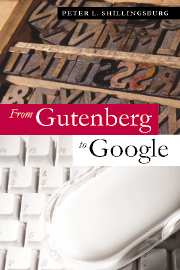
P. L. Shillingsburg, From Gutenberg to Google. Electronic Representations of Literary Texts

Parution livre

Information publiée le jeudi 12 octobre 2006 par Julien Desrochers


_blank


SHILLINGSBURG, Peter L., From Gutenberg to Google. Electronic Representations of Literary Texts, Cambridge University Press, 2006, 222 pp.


ISBN: 0521683475


Book Description

 
As technologies for electronic texts develop into ever more sophisticated engines for capturing different kinds of information, radical changes are underway in the way we write, transmit and read texts. In this thought-provoking work, Peter Shillingsburg considers the potentials and pitfalls, the enhancements and distortions, the achievements and inadequacies of electronic editions of literary texts. In tracing historical changes in the processes of composition, revision, production, distribution and reception, Shillingsburg reveals what is involved in the task of transferring texts from print to electronic media. He explores the potentials, some yet untapped, for electronic representations of printed works in ways that will make the electronic representation both more accurate and more rich than was ever possible with printed forms. However, he also keeps in mind the possible loss of the book as a material object and the negative consequences of technology.

About the Author

 
Peter L. Shillingsburg is Professor of English at De Montfort University, Leicester, UK.


Contents


Preface;

1. Manuscript, book, and text in the twenty-first century;

2. Complexity, endurance, accessibility, beauty, sophistication, and scholarship;

3. Script act theory;

4. An electronic infrastructure for script acts;

5. Victorian fiction: shapes shaping reading;

6. The dank cellar of electronic texts;

7. Negotiating conflicting aims in textual scholarship;

8. Hagiolatry, cultural engineering, monument building, and other functions of scholarly editing;

9. The aesthetic object: 'the subject of our mirth';

10. Ignorance in literary studies;

Bibliography.


Url de référence :
http://www.cambridge.org/


Derniers ouvrages parus :

Lexique nomade

A. Cousin de Ravel, Quignard, Maître de lecture. Lire, vivre, écrire

P. Engel, Les Lois de l'esprit. Julien Benda ou la raison

M. Crouzet, M. Myself ou La Vie de Stendhal (nouvelle version)

Laurence Brogniez (dir.), Écrits voyageurs. Les artistes et l'ailleurs

O. Biaggini, B. Milland-Bove (dir.), Miracles d'un autre genre  

Sévigné, Lettres de l'année 1671

A. Pope & J. Swift, Pensées sur différents sujets

H. Melville, Le Marchand de paratonnerres, suivi de La Véranda

Le Dit des Heiké

S. Kierkegaard, La Crise et une crise dans la vie d'une actrice

E. Maigret et M. Stefanelli (dir.), La Bande dessinée : une médiaculture

I. Raynauld, Lire et écrire un scénario - Le Scénario de film comme texte

J.-F. Bédia, Les Ecritures africaines face à la logique actuelle du comparatisme

Eusèbe de Césarée, Histoire ecclésiastique. Commentaire - Tome I : Études d'introduction

P. Engel, Les lois de l'esprit, Julien Benda ou la raison  

P. E. Fobah, Introduction à une poétique et une stylistique de la littérature africaine

M.-C. Alexandrine-Sinapah, Itinéraire d'un esclave-poète à Cuba - Juan Francisco Manzano (1797-1854) entre littérature et histoire

Cl. Launchbury, Music, Poetry, Propaganda. Constructing French Cultural Soundscapes at the BBC during the Second World War 

O. Rosenthal, Ils ne sont pour rien dans mes larmes

A. Alciato, Il libro degli Emblemi, secondo le edizioni del 1531 e del 1534

Marc Azéma, La Préhistoire du cinéma

J. Milly, Au seuil de l'image

I. Mons, Lou Andreas-Salomé. En toute liberté

N. Redouane, Lecture(s) de Rachid Mimouni

Fil d'informations RSS Fil d'information RSS   Fabula sur Facebook Fabula sur Facebook   Fabula sur Twitter Fabula sur Twitter