Fabula, la recherche en littérature (actu)

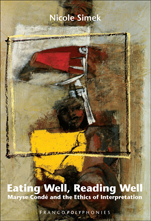
Nicole Simek, Eating Well, Reading Well. Maryse Condé and the Ethics of Interpretation.

Parution livre avec compte rendu à paraître prochainement dans Acta

Parution : 1 janvier 2008.

Information publiée le jeudi 20 décembre 2007 par Bérenger Boulay (source : Rodopi edition)


_blank

 Nicole Simek


Eating Well, Reading Well.
Maryse Condé and the Ethics of Interpretation.

Rodopi

Amsterdam/New York, NY, 2008, 235 pp.
ISBN: 978-90-420-2327-7

Prière d'insérer

While rejecting a conception of literature as moral philosophy, or a device for imparting particular morals to the reader through exemplary characters and plots, Maryse Condé has displayed throughout her writing career a strong valorization of literature as ethical critique. This study examines her singular approach to literary commitment as a critical reworking of aesthetic models and modes of interpretation. Focusing on four dominant problematics in Condé's work—history and globalization in La Belle Créole and Moi, Tituba sorcière...noire de Salem, intertextuality and reception in La migration des coeurs and Célanire cou-coupé, trauma and subjectivity in En attendant le bonheur and Desirada, community and ethics in Traversée de la mangrove and Histoire de la femme cannibale—this analysis proposes to elucidate how, and to what ends, Condé engages, and alters, approaches to reading, staging the problematic, yet pragmatic, need to read well. This hermeneutic imperative foregrounds the need to engage with texts, to cannibalize texts while recognizing their fundamental opacity and inexhaustibility, their resistance to the reader's interpretive habits.

Table of Contents
Acknowledgments
Introduction. Interpreting through Example
Chapter 1. Reading History: The Example of the Past after Globalization
Chapter 2. Rusing with the Canon: Insolent Imitation, Parodic Intertextuality
Chapter 3. Writing Violence: Collective Traumas, Singular Pasts
Chapter 4. The Cannibal Reader: Digesting the Other, Interpreting Community
Conclusion. Comme un Indien Tupinamba...
Bibliography
Index

Nicole Simek is an Assistant Professor of Foreign Languages and Literatures at Whitman College. Specializing in French Caribbean literature, Simek's research interests include the intersection of politics and literature in Caribbean fiction, trauma theory, and sociological approaches to literature.


Url de référence :
http://www.rodopi.nl


Derniers ouvrages parus :

Lexique nomade

A. Cousin de Ravel, Quignard, Maître de lecture. Lire, vivre, écrire

P. Engel, Les Lois de l'esprit. Julien Benda ou la raison

M. Crouzet, M. Myself ou La Vie de Stendhal (nouvelle version)

Laurence Brogniez (dir.), Écrits voyageurs. Les artistes et l'ailleurs

O. Biaggini, B. Milland-Bove (dir.), Miracles d'un autre genre  

Sévigné, Lettres de l'année 1671

A. Pope & J. Swift, Pensées sur différents sujets

H. Melville, Le Marchand de paratonnerres, suivi de La Véranda

Le Dit des Heiké

S. Kierkegaard, La Crise et une crise dans la vie d'une actrice

E. Maigret et M. Stefanelli (dir.), La Bande dessinée : une médiaculture

I. Raynauld, Lire et écrire un scénario - Le Scénario de film comme texte

J.-F. Bédia, Les Ecritures africaines face à la logique actuelle du comparatisme

Eusèbe de Césarée, Histoire ecclésiastique. Commentaire - Tome I : Études d'introduction

P. Engel, Les lois de l'esprit, Julien Benda ou la raison  

P. E. Fobah, Introduction à une poétique et une stylistique de la littérature africaine

M.-C. Alexandrine-Sinapah, Itinéraire d'un esclave-poète à Cuba - Juan Francisco Manzano (1797-1854) entre littérature et histoire

Cl. Launchbury, Music, Poetry, Propaganda. Constructing French Cultural Soundscapes at the BBC during the Second World War 

O. Rosenthal, Ils ne sont pour rien dans mes larmes

A. Alciato, Il libro degli Emblemi, secondo le edizioni del 1531 e del 1534

Marc Azéma, La Préhistoire du cinéma

J. Milly, Au seuil de l'image

I. Mons, Lou Andreas-Salomé. En toute liberté

N. Redouane, Lecture(s) de Rachid Mimouni

Fil d'informations RSS Fil d'information RSS   Fabula sur Facebook Fabula sur Facebook   Fabula sur Twitter Fabula sur Twitter