Fabula, la recherche en littérature (actu)

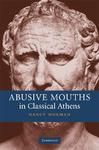
N. Worman, Abusive Mouths in Classical Athens

Parution livre

Information publiée le vendredi 16 octobre 2009 par Frédérique Fleck (source : BMCR)


_blank


Nancy Worman, Abusive Mouths in Classical Athens,  Cambridge/New York:  Cambridge University Press, 2008.  Pp. xi, 385.   ISBN 9780521857871.   $99.00.  
Recension par Bruce Krajewski (Texas Woman's University) dans Bryn Mawr Classical Review 2009.10.27.

Extraits en ligne sur amazon.fr et books.google.

Présentation de l'éditeur:

This study of the language of insult charts abuse in classical Athenian literature that centres on the mouth and its appetites, especially talking, eating, drinking, and sexual activities. Attic comedy, Platonic dialogue, and fourth-century oratory often deploy insulting depictions of the mouth and its excesses in order to deride professional speakers as sophists, demagogues, and women. Although the patterns of imagery explored are very prominent in ancient invective and later western literary traditions, this is the first book to discuss this phenomenon in classical literature. It responds to a growing interest in both abusive speech genres and the representation of the body, illuminating an iambic discourse that isolates the intemperate mouth as a visible emblem of behaviours ridiculed in the democratic arenas of classical Athens.

Table des matières:

Introduction 1
1 The mouth and its abuses in epic, lyric and tragedy 25
2 Open mouths and abusive talk in Aristophanes 62
3 Gluttonous speechifying in Euripides' Cyclops 121
4 Crude talk and fancy fare in Plato 153
5 Defamation and oral excesses in Aeschines and Demosthenes 213
6 The intemperate mouth in Aristotle and Theophrastus 275
Epilogue 319
Bibliography 325
Index locorum 346
General index 371


Derniers ouvrages parus :

Lexique nomade

A. Cousin de Ravel, Quignard, Maître de lecture. Lire, vivre, écrire

P. Engel, Les Lois de l'esprit. Julien Benda ou la raison

M. Crouzet, M. Myself ou La Vie de Stendhal (nouvelle version)

Laurence Brogniez (dir.), Écrits voyageurs. Les artistes et l'ailleurs

O. Biaggini, B. Milland-Bove (dir.), Miracles d'un autre genre  

Sévigné, Lettres de l'année 1671

A. Pope & J. Swift, Pensées sur différents sujets

H. Melville, Le Marchand de paratonnerres, suivi de La Véranda

Le Dit des Heiké

S. Kierkegaard, La Crise et une crise dans la vie d'une actrice

E. Maigret et M. Stefanelli (dir.), La Bande dessinée : une médiaculture

I. Raynauld, Lire et écrire un scénario - Le Scénario de film comme texte

J.-F. Bédia, Les Ecritures africaines face à la logique actuelle du comparatisme

Eusèbe de Césarée, Histoire ecclésiastique. Commentaire - Tome I : Études d'introduction

P. Engel, Les lois de l'esprit, Julien Benda ou la raison  

P. E. Fobah, Introduction à une poétique et une stylistique de la littérature africaine

M.-C. Alexandrine-Sinapah, Itinéraire d'un esclave-poète à Cuba - Juan Francisco Manzano (1797-1854) entre littérature et histoire

Cl. Launchbury, Music, Poetry, Propaganda. Constructing French Cultural Soundscapes at the BBC during the Second World War 

O. Rosenthal, Ils ne sont pour rien dans mes larmes

A. Alciato, Il libro degli Emblemi, secondo le edizioni del 1531 e del 1534

Marc Azéma, La Préhistoire du cinéma

J. Milly, Au seuil de l'image

I. Mons, Lou Andreas-Salomé. En toute liberté

N. Redouane, Lecture(s) de Rachid Mimouni

Fil d'informations RSS Fil d'information RSS   Fabula sur Facebook Fabula sur Facebook   Fabula sur Twitter Fabula sur Twitter