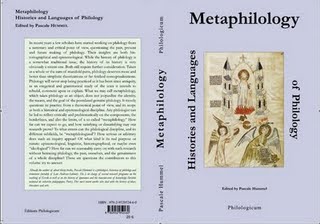
Metaphilology: Histories and Languages of Philology
Textes rassemblés par Pascale Hummel
Paris: Philologicum, 2009, 320 p.
- Isbn 13 (ean): 9782952952460
- format 16x24
- 20 euros
Présentation de l'éditeur:
In recent years a few scholars have started working on philology from a summary and critical point of view, questioning the past, present and future making of philology. Their insights are both historiographical and epistemological. While the history of philology is a somewhat traditional issue, the history of its history is very obviously a recent one. Both still require further consideration. Taken as a whole or the sum of manifold parts, philology deserves more and better than simplistic theorizations or far-fetched conceptualizations.
Philology will never stop being practiced as it has been since antiquity, as an exegetical and grammatical study of the texts it intends to rebuild, comment upon or explain. What we may call metaphilology, which takes philology as an object, does not jeopardize the identity, the means, and the goal of the postulated genuine philology. It mostly questions its practice from a theoretical point of view, and its scope as both a historical and epistemological discipline. Any philologist can be led to reflect critically and problematically on the components, the borderlines, and also the limits, of a so-called “metaphilology.” How far can we expect to go, and how satisfying or dissatisfying may our research prove? To what extent can the philological discipline, and its different subfields, be “metaphilologized”? How serious or arbitrary does such an inquiry appear? Of what kind is its real purpose or nature: epistemological, linguistic, historiographical, or maybe even “ideological”? How far can we reasonably carry on with such research without betraying philology, the past, ourselves, and the genuineness of a whole discipline? These are questions the contributors to this volume try to answer.
Already the author of about thirty books, Pascale Hummel is a philologist, historian of philology and translator (notably of Lou Andreas-Salomé). She is in charge of several research programs on the teaching of Greek as well as on the history of ignorance and the transmission of knowledge (Institut national de recherche pédagogique, Paris). Her most recent works also deal with the history of ideas, literature and arts.
[Page Fabula associée: appel à contributions pour ce volume]