Fabula, la recherche en littérature (actu)

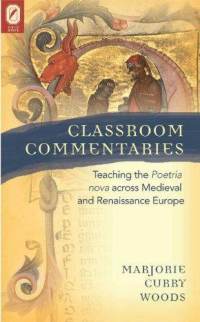
M. Curry Woods, Classroom Commentaries. Teaching the Poetria nova across Medieval and Renaissance Europe

Parution livre avec compte rendu publié sur Acta

Information publiée le mardi 4 septembre 2012 par Amandine Mussou


_blank

Compte rendu publié dans Acta fabula : "À l’école des manuscrits" par Elsa Marguin-Hamont.


***


Marjorie Curry Woods, Classroom Commentaries. Teaching the Poetria nova across Medieval and Renaissance Europe

Columbus : The Ohio State University Press, 2010.

EAN : 9780814211090

Prix : 89,95$

367 p.

Présentation de l'éditeur :

With an unusually broad scope encompassing how Europeans taught and learned reading and writing at all levels, Classroom Commentaries: Teaching the Poetria nova across Medieval and Renaissance Europe provides a synoptic picture of medieval and early modern instruction in rhetoric, poetics, and composition theory and practice. As Marjorie Curry Woods convincingly argues, the decision of Geoffrey of Vinsauf (fl. 1200) to write his rhetorical treatise in verse resulted in a unique combination of rhetorical doctrine, poetic examples, and creative exercises that proved malleable enough to inspire teachers for three centuries.

Based on decades of research, this book excerpts, translates, and analyzes teachers’ notes and commentaries in the more than two hundred extant manuscripts of the text. We learn the reasons for the popularity of the Poetria nova among medieval and early Renaissance teachers, how prose as well as verse genres were taught, why the Poetria nova was a required text in central European universities, its attractions for early modern scholars and historians, and how we might still learn from it today. Woods’ monumental achievement will allow modern scholars to see the Poetria nova as earlier Europeans did: a witty and perennially popular text central to the experience of almost every student.


Derniers ouvrages parus :

J.-F. Chassay, Au cœur du sujet : imaginaire du gène

F. Teinturier & B. Terrisse (dir.), "Ich" de Wolfgang Hilbig. Littérature, identité et faux-semblants

J.-M. Moura, Littératures francophones et théorie postcoloniale

J.-M. Apostolidès, Lettre à Hergé

T. Groensteen, Entretiens avec Joann Sfar

B. Urbani, Jongleurs des temps modernes. Dario Fo et Franca Rame

M.-C. Hubert et F. Bernard (dir.), Relire Koltès

J.-M. Rey, Histoires d'escrocs. t. I. Le Comte de Montecristo

R. Ogien, L'État nous rend-il meilleurs ?

Jean-François Chassay, Daniel Grenier et William S. Messier (dir.), Les Voies de l’évolution. De la pertinence du darwinisme en littérature

L. Dupuy, Géographies. le territoire et ses paradoxes

H. Machinal (dir.), Le Savant fou

P. Maurus et P. Popovic (dir.), Actualité de la sociocritique

M. Serra, Italo Svevo ou l'Antivie

E. Buch, N. Donin & L. Feneyrou (dir.), Du politique en analyse musicale

A. Compagnon, L'Été avec Montaigne

B. Binoche, Les trois sources des philosophies de l’histoire (1764-1798)

A. Rey, Des pensées et des mots

A. Crasson (dir.), Edmond Jabès : l’exil en partage

M. Moser-Verrey, Isabelle de Charrière : salonnière virtuelle. Un itinéraire d'écriture au XVIIIe s.

S.-P.  Hardy, Mes Loisirs, ou Journal d'événements tels qu'ils parviennent à ma connaissance (1753-1789), vol. 4

Y. Citton et L. Dumasy, Le Moment idéologique - Entre émergence de la littérature et constitution des sciences de l'homme

A. Richard, L'Autofiction et les femmes - Un chemin vers l'altruisme ?

D. Cahen, À livre ouvert

M. Lo Nostro, La dictionnairique bilingue. Analyse et suggestions

Fil d'informations RSS Fil d'information RSS   Fabula sur Facebook Fabula sur Facebook   Fabula sur Twitter Fabula sur Twitter