Compte rendu publié dans Acta fabula : "Les Anciens contre-attaquent ou la Querelle revisitée" par Marie-Pierre Harder.
***
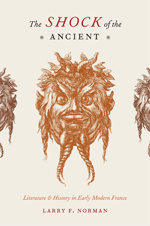
Larry F. Norman, The Shock of the Ancient
Chicago : The University of Chicago Press, coll. "Literature and History in Early Modern France", 2011.
EAN 9780226591483
288 p.
Prix 45USD
Présentation de l'éditeur :
The cultural battle known as the Quarrel of the Ancients and Moderns served as a sly cover for more deeply opposed views about the value of literature and the arts. One of the most public controversies of early modern Europe, the Quarrel has most often been depicted as pitting antiquarian conservatives against the insurgent critics of established authority. The Shock of the Ancient turns the canonical vision of those events on its head by demonstrating how the defenders of Greek literature—rather than clinging to an outmoded tradition—celebrated the radically different practices of the ancient world.
At a time when the constraints of decorum and the politics of French absolutism quashed the expression of cultural differences, the ancient world presented a disturbing face of otherness. Larry F. Norman explores how the authoritative status of ancient Greek texts allowed them to justify literary depictions of the scandalous. The Shock of the Ancient surveys the diverse array of aesthetic models presented in these ancient works and considers how they both helped to undermine the rigid codes of neoclassicism and paved the way for the innovative philosophies of the Enlightenment. Broadly appealing to students of European literature, art history, and philosophy, this book is an important contribution to early modern literary and cultural debates.
Sommaire :
Acknowledgments
Introduction: Experiencing Antiquity
PART 1 Historical Sensibility
1 Whose Ancients and Moderns?
2 Asserting Modernity
3 Splintered Paths of Progress
4 Antiquity without Authority
PART 2 The Shock
5 Why the Scandal?
6 Modernity and Monarchy
7 The Pagan Menace
8 Morality and Sociability
9 The Ancients Respond
PART 3 Aesthetics: The Geometric and the Sublime
10 Philosophy’s Turn
11 The Ineffable Effect
Conclusion: After the Quarrel
Notes
Bibliography
Index