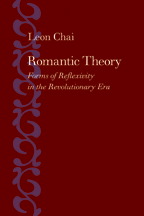
CHAI, Leon, Romantic Theory. Forms of Reflexivity in the Revolutionary Era, Johns Hopkins University Press, 2006, 304 p.
ISBN : 0-8018-8396-2
This original study explores the new idea of theory that emerged in the wake of the French Revolution. Leon Chai sees in the Romantic age a significant movement across several broad fields of intellectual endeavor, from theoretical concepts to an attempt to understand how they arise. He contends that this movement led to a spatial treatment of concepts, the primacy of development over concepts, and the creation of metatheory, or the formal analysis of theory.
Chai begins with P. B. Shelley on the need for conceptual framework, or theory. He then considers how Friedrich Wolf and Friedrich Schlegel shift from a preoccupation with antiquity to a heightened self-awareness of Romantic nostalgia for that lost past. He finds a similar reflexivity in Napoleon's battle plan at Jena and, subsequently, in Hegel's move from substance to subject. Chai then turns to the sciences: Xavier Bichat's rejection of the idea of a unitary vital principle for life as process; the chemical theory of matter developed by Humphry Davy; and the work of Évariste Galois, whose proof of the solvability of equations using radicals ushered in the age of metatheory.
Chai concludes with reactions to theory: Coleridge's proposal of the conflict between reason and understanding as a model of theory, Mary Shelley's effort to replace theory with a different kind of relationship to external others, and Hölderlin's reflection on the limits of representation and the possibility of fulfillment beyond it.
Leon Chai is a professor of English and comparative literature at the University of Illinois at Urbana–Champaign.