Compte rendu publié dans le dossier critique d'Acta fabula "Après le bovarysme" (mars 2012, Vol. 13, n°3) et en parallèle du numéro de Fabula-LHT sur le même sujet : "« Une façon de s’imaginer comme individu » : Barthes lecteur" par Guillaume Bellon.
***
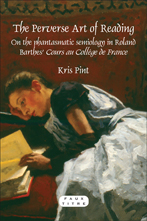
Kris Pint, The Pervers Art of Reading. On the phantasmatic semiology in Roland Barthes' Cours au Collège de France.
New York : Rodopi, coll. "Faux Titre", 2010.
293 p.
Prix : 59EUR.
EAN : 9789042030923
Présentation de l'éditeur :
‘I sincerely believe that at the origin of teaching such as this we must always locate a fantasy’. This provoking remark was the starting point of the four lecture courses Roland Barthes taught as professor of literary semiology at the Collège de France. In these last years of his life, Barthes developed a perverse reading theory in which the demonic stupidity of the fantasy becomes an active force in the creation of new ways of thinking and feeling.
The perverse art of reading offers the first extensive monograph on these lecture courses. The first part examines the psychoanalytical and philosophical intertexts of Barthes’ ‘active semiology’ (Lacan, Kristeva, Winnicott, Nietzsche, Deleuze and Foucault), while the second part discusses his growing attention for the intimate, bodily involvement in the act of reading. Subsequently, this study shows how Barthes’ phantasmatic reading strategy radically reviews the notions of space, detail and the untimely in fiction, as well as the figure of the author and his own role as a teacher.
It becomes clear that the interest of Barthes’ lecture courses goes well beyond semiology and literary criticism, searching the answer to the ethical question par excellence: how to become what one is, how to live a good life.