Fabula, la recherche en littérature (actu)

J. Stalnaker, The Unfinished Enlightenment. Description in the Age of the Encyclopedia

Parution livre avec compte rendu publié sur Acta

Information publiée le mardi 25 mai 2010 par Matthieu Vernet


_blank

Compte rendu publié dans Acta fabula : "La description entre épistémologie, poétique, représentation & politique" par Chistof Schöch.


***


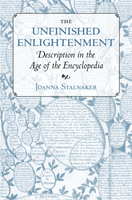
Joanna Stalnaker, The Unfinished Enlightenment. Description in the Age of the Encyclopedia

Ithaca et Londres : Cornell University Press, 2010.

EAN 9780801448645

256 p.

Prix 45USD

Présentation de l'éditeur :

In The Unfinished Enlightenment, Joanna Stalnaker offers a fresh look at the French Enlightenment by focusing on the era's vast, collective attempt to compile an ongoing and provisional description of the world. Through a series of readings of natural histories, encyclopedias, scientific poetry, and urban topographies, the book uncovers the deep epistemological and literary tensions that made description a central preoccupation for authors such as Buffon, Bernardin de Saint-Pierre, Diderot, Delille, and Mercier.

Stalnaker argues that Enlightenment description was the site of competing truth claims that would eventually resolve themselves in the modern polarity between literature and science. By the mid-nineteenth century, the now habitual association between description and the novel was already firmly anchored in French culture, but just a century earlier, in the diverse network of articles on description in Diderot and d'Alembert's Encyclopédie and in the works derived from it, there was not a single mention of the novel. Instead, we find articles on description in natural history, geometry, belles-lettres, and poetry. Stalnaker builds on the premise that the tendency to view description as the inevitable (and subservient) partner of narration—rather than as a universal tool for making sense of knowledge in all fields—has obscured the central place of description in Enlightenment discourse. As a result, we have neglected some of the most original and experimental works of the eighteenth century.


Url de référence :
http://www.cornellpress.cornell.edu/cup_detail.taf?ti_id=5614


Derniers ouvrages parus :

J.-F. Chassay, Au cœur du sujet : imaginaire du gène

F. Teinturier & B. Terrisse (dir.), "Ich" de Wolfgang Hilbig. Littérature, identité et faux-semblants

J.-M. Moura, Littératures francophones et théorie postcoloniale

J.-M. Apostolidès, Lettre à Hergé

T. Groensteen, Entretiens avec Joann Sfar

B. Urbani, Jongleurs des temps modernes. Dario Fo et Franca Rame

M.-C. Hubert et F. Bernard (dir.), Relire Koltès

J.-M. Rey, Histoires d'escrocs. t. I. Le Comte de Montecristo

R. Ogien, L'État nous rend-il meilleurs ?

Jean-François Chassay, Daniel Grenier et William S. Messier (dir.), Les Voies de l’évolution. De la pertinence du darwinisme en littérature

L. Dupuy, Géographies. le territoire et ses paradoxes

H. Machinal (dir.), Le Savant fou

P. Maurus et P. Popovic (dir.), Actualité de la sociocritique

M. Serra, Italo Svevo ou l'Antivie

E. Buch, N. Donin & L. Feneyrou (dir.), Du politique en analyse musicale

A. Compagnon, L'Été avec Montaigne

B. Binoche, Les trois sources des philosophies de l’histoire (1764-1798)

A. Rey, Des pensées et des mots

A. Crasson (dir.), Edmond Jabès : l’exil en partage

M. Moser-Verrey, Isabelle de Charrière : salonnière virtuelle. Un itinéraire d'écriture au XVIIIe s.

S.-P.  Hardy, Mes Loisirs, ou Journal d'événements tels qu'ils parviennent à ma connaissance (1753-1789), vol. 4

Y. Citton et L. Dumasy, Le Moment idéologique - Entre émergence de la littérature et constitution des sciences de l'homme

A. Richard, L'Autofiction et les femmes - Un chemin vers l'altruisme ?

D. Cahen, À livre ouvert

M. Lo Nostro, La dictionnairique bilingue. Analyse et suggestions

Fil d'informations RSS Fil d'information RSS   Fabula sur Facebook Fabula sur Facebook   Fabula sur Twitter Fabula sur Twitter