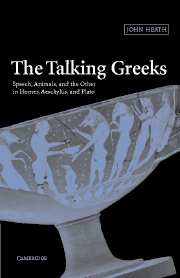
John Heath, The Talking Greeks: Speech, Animals, and the Other in Homer, Aeschylus, and Plato.
Cambridge: Cambridge University Press, 2005, 400 p., Isbn (ean13): 9780521832649.
Recension par Deborah Levine Gera (Hebrew University of Jerusalem) dans Bryn Mawr Classical Review: 2008.07.62
Présentation de l'éditeur:
When considering the question of what makes ushuman, the ancient Greeks provided numerous suggestions. This bookargues that the defining criterion in the Hellenic world, however, wasthe most obvious one: speech. It explores how it was the capacity forauthoritative speech which was held to separate humans from otheranimals, gods from humans, men from women, Greeks from non-Greeks,citizens from slaves, and the mundane from the heroic. John Heathillustrates how Homer's epics trace the development of immature youngmen into adults managing speech in entirely human ways and how inAeschylus' Oresteia only human speech can disentangle man, beast, and god. Plato's Dialoguesare shown to reveal the consequences of Socratically imposed silence.With its examination of the Greek focus on speech, animalization, andstatus, this book offers new readings of key texts and providessignificant insights into the Greek approach to understanding our world.
JOHN HEATH is Professor of Classicsat Santa Clara University. He is the author of numerous articles onLatin and Greek literature, myth and culture. His previous publicationsinclude Actaeon, the Unmannerly Intruder (1992), Who Killed Homer? (with Victor Davis Hanson, 1998; revised edition, 2001) and Bonfire of the Humanities (with Victor Davis Hanson and Bruce Thornton, 2001).
Sommaire:
Introduction
Part I. Speech, Animals, and Human Status in Homer: 1. Bellowing like a bull: humans and other animals in Homer
2. Controlling language: Telemachus learns to speak
3. Talking through the heroic code: Achilles learns to tell tales
Part II. Listening for the Other in Classical Greece: 4. Making a difference: the silence of otherness
Part III. Speech, Animals, and Human Status in Classical Athens: 5. Disentangling the beast: humans and other animals in the Oresteia
6. Socratic silence: the shame of the Athenians
Epilogue.