Fabula, la recherche en littérature (actu)

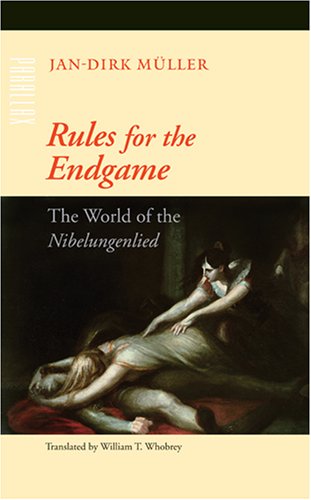
J.-D. Müller, Rules for the Endgame. The World of the Nibelungenlied (trad. de l'allemand)

Parution livre

Information publiée le lundi 24 novembre 2008 par Bérenger Boulay


_blank

Jan-Dirk Müller, Rules for the Endgame. The World of the Nibelungenlied, Baltimore: The Johns Hopkins University Press, xv-562p.

Traduit de l'allemand par William T. Whobrey.

ISBN: 9780801887024.


Recension par  Will Hasty (University of Florida) dans The Medieval ReviewTMR 08.11.19

Lire des extraits de l'ouvrage:

"Look inside" (Amazon) et books.google

Présentation de l'éditeur:

The source of Richard Wagner's Ring Cycle, the Nibelungenlied occupies a unique place in medieval literary history. Commonly seen as the paradigmatic example of national epic, its interpretation has long been colored by the later evolution of German cultural tradition. In Rules for the Endgame Jan-Dirk Mller argues that the literary reception of the Nibelungenlied was problematic long before the twentieth century. Here Mller uncovers the complex and heterogeneous cultural context from which the poem emerged. He challenges scholarly readers to move beyond modern methods of criticism and analysis -- specifically, in their expectations of coherence, agreement, and integrity -- and to look for other possibilities and methods of interpretation. He recommends a reading that elucidates meaningful linkages, isotopes, and structural recurrences on the epic's different levels and thematic subjects. This groundbreaking interpretation offers a new approach to the reading of medieval literature and revolutionizes the study of the Nibelungenlied itself -- providing a richer understanding of the work's significance both in its era and for our own.


Derniers ouvrages parus :

Lexique nomade

A. Cousin de Ravel, Quignard, Maître de lecture. Lire, vivre, écrire

P. Engel, Les Lois de l'esprit. Julien Benda ou la raison

M. Crouzet, M. Myself ou La Vie de Stendhal (nouvelle version)

Laurence Brogniez (dir.), Écrits voyageurs. Les artistes et l'ailleurs

O. Biaggini, B. Milland-Bove (dir.), Miracles d'un autre genre  

Sévigné, Lettres de l'année 1671

A. Pope & J. Swift, Pensées sur différents sujets

H. Melville, Le Marchand de paratonnerres, suivi de La Véranda

Le Dit des Heiké

S. Kierkegaard, La Crise et une crise dans la vie d'une actrice

E. Maigret et M. Stefanelli (dir.), La Bande dessinée : une médiaculture

I. Raynauld, Lire et écrire un scénario - Le Scénario de film comme texte

J.-F. Bédia, Les Ecritures africaines face à la logique actuelle du comparatisme

Eusèbe de Césarée, Histoire ecclésiastique. Commentaire - Tome I : Études d'introduction

P. Engel, Les lois de l'esprit, Julien Benda ou la raison  

P. E. Fobah, Introduction à une poétique et une stylistique de la littérature africaine

M.-C. Alexandrine-Sinapah, Itinéraire d'un esclave-poète à Cuba - Juan Francisco Manzano (1797-1854) entre littérature et histoire

Cl. Launchbury, Music, Poetry, Propaganda. Constructing French Cultural Soundscapes at the BBC during the Second World War 

O. Rosenthal, Ils ne sont pour rien dans mes larmes

A. Alciato, Il libro degli Emblemi, secondo le edizioni del 1531 e del 1534

Marc Azéma, La Préhistoire du cinéma

J. Milly, Au seuil de l'image

I. Mons, Lou Andreas-Salomé. En toute liberté

N. Redouane, Lecture(s) de Rachid Mimouni

Fil d'informations RSS Fil d'information RSS   Fabula sur Facebook Fabula sur Facebook   Fabula sur Twitter Fabula sur Twitter