Fabula, la recherche en littérature (actu)

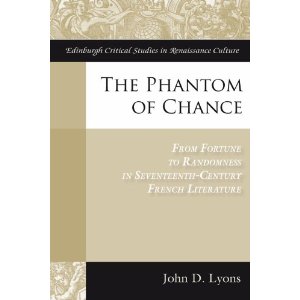
J. D. Lyons, The Phantom of Chance. Form Fortune to Randomness in Seventeenth-Century French Literature

Parution livre avec compte rendu à paraître prochainement dans Acta

Information publiée le lundi 2 janvier 2012 par Matthieu Vernet


_blank

John D. Lyons, The Phantom of Chance. Form Fortune to Randomness in Seventeenth-Century French Literature

Edinbourg : Edinburgh University Press, coll. "Edinburgh Critical Studies in Renaissance Culture", 2011.

EAN 9780748645152

240 p.

Prix 65£

Présentation de l'éditeur :

How the classical and medieval conceptions of Fortune shifted to the modern notion of chance

Is chance nothing more than a projection of human desire on to the world?

In this fascinating new study, John Lyons argues that the idea of chance assumed new vigour in the late Renaissance, when converging philosophical and literary currents demystified the powerful concept of Fortune, sensitizing writers to the relationship between human desire and the world’s apparent randomness.

Up to now, the story of chance has been written by historians of mathematical thought and has focused on calculation, probability and gambling. Lyons, by contrast, highlights the ethical, aesthetic and even erotic aspects of chance. He offers detailed readings of the works of major French authors - Montaigne, Corneille, Lafayette, Scudéry, Pascal, Racine, Bossuet, and La Bruyère.

Key Features

  • Renews our understanding of romance, tragedy, comedy & religious polemic in the light of the changed conceptions of the fortuitous
  • Shows how the emergence of suspense and subjective interest are linked to the shift from Fortune to randomness
  • Proposes a new view on how religious writers, faced with the sceptical challenge of late Renaissance thought, integrated chance into the post-Reformation mainstream of Catholic teachings


Derniers ouvrages parus :

Lexique nomade

A. Cousin de Ravel, Quignard, Maître de lecture. Lire, vivre, écrire

P. Engel, Les Lois de l'esprit. Julien Benda ou la raison

M. Crouzet, M. Myself ou La Vie de Stendhal (nouvelle version)

Laurence Brogniez (dir.), Écrits voyageurs. Les artistes et l'ailleurs

O. Biaggini, B. Milland-Bove (dir.), Miracles d'un autre genre  

Sévigné, Lettres de l'année 1671

A. Pope & J. Swift, Pensées sur différents sujets

H. Melville, Le Marchand de paratonnerres, suivi de La Véranda

Le Dit des Heiké

S. Kierkegaard, La Crise et une crise dans la vie d'une actrice

E. Maigret et M. Stefanelli (dir.), La Bande dessinée : une médiaculture

I. Raynauld, Lire et écrire un scénario - Le Scénario de film comme texte

J.-F. Bédia, Les Ecritures africaines face à la logique actuelle du comparatisme

Eusèbe de Césarée, Histoire ecclésiastique. Commentaire - Tome I : Études d'introduction

P. Engel, Les lois de l'esprit, Julien Benda ou la raison  

P. E. Fobah, Introduction à une poétique et une stylistique de la littérature africaine

M.-C. Alexandrine-Sinapah, Itinéraire d'un esclave-poète à Cuba - Juan Francisco Manzano (1797-1854) entre littérature et histoire

Cl. Launchbury, Music, Poetry, Propaganda. Constructing French Cultural Soundscapes at the BBC during the Second World War 

O. Rosenthal, Ils ne sont pour rien dans mes larmes

A. Alciato, Il libro degli Emblemi, secondo le edizioni del 1531 e del 1534

Marc Azéma, La Préhistoire du cinéma

J. Milly, Au seuil de l'image

I. Mons, Lou Andreas-Salomé. En toute liberté

N. Redouane, Lecture(s) de Rachid Mimouni

Fil d'informations RSS Fil d'information RSS   Fabula sur Facebook Fabula sur Facebook   Fabula sur Twitter Fabula sur Twitter