Fabula, la recherche en littérature (actu)

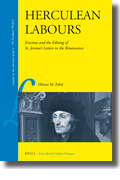
H. M. Pabel, Herculean Labours: Erasmus and the Editing of St. Jerome's Letters in the Renaissance

Parution livre

Parution : juillet 2008.

Information publiée le jeudi 4 septembre 2008 par Sophie Rabau


_blank

Herculean Labours: Erasmus and the Editing of St. Jerome's Letters in the Renaissance

Par Hilmar M. Pabel

Brill

Series: Library of the Written Word, 5

ISBN-13 (i)The ISBN (International Standard Book Number) has been changed from 10 to 13 digits on 1 January 2007: 978 90 04 16961 6

Table of contents

Introduction

I. Jerome in Print, 1467-1600

II. Classifying Jerome

III. Portraying Jerome

IV. Elucidating Jerome

Conclusion

Bibliography

Index

.

Presentation de l'éditeur

The first monograph in English on Erasmus of Rotterdam as an editor of St. Jerome, this book belongs to the growing scholarship on the reception of the Church Fathers in early modern Europe. Erasmus, like other Renaissance humanists, particularly admired Jerome (d. 419 or 420), and he expressed his admiration most conspicuously in his edition of Jerome's letters. Proclaiming his editorial Herculean labours, Erasmus energetically promoted himself and his publication. Erasmus' self-promotion cannot be reduced to a secular appropriation of Jerome, however. A detailed examination of a variety of editorial interventions demonstrates Erasmus' religious purpose, his debt to previous editorial traditions as well as his editorial novelty, and his influence on subsequent sixteenth-century editions of Jerome.

L'auteur

Hilmar M. Pabel, Ph.D. (1992) in History, YaleUniversity, is Professor of History at SimonFraserUniversity. He has published widely on the religious thought of Erasmus of Rotterdam, including Conversing with God: Prayer in Erasmus' Pastoral Writings (Toronto, 1997).


Derniers ouvrages parus :

Lexique nomade

A. Cousin de Ravel, Quignard, Maître de lecture. Lire, vivre, écrire

P. Engel, Les Lois de l'esprit. Julien Benda ou la raison

M. Crouzet, M. Myself ou La Vie de Stendhal (nouvelle version)

Laurence Brogniez (dir.), Écrits voyageurs. Les artistes et l'ailleurs

O. Biaggini, B. Milland-Bove (dir.), Miracles d'un autre genre  

Sévigné, Lettres de l'année 1671

A. Pope & J. Swift, Pensées sur différents sujets

H. Melville, Le Marchand de paratonnerres, suivi de La Véranda

Le Dit des Heiké

S. Kierkegaard, La Crise et une crise dans la vie d'une actrice

E. Maigret et M. Stefanelli (dir.), La Bande dessinée : une médiaculture

I. Raynauld, Lire et écrire un scénario - Le Scénario de film comme texte

J.-F. Bédia, Les Ecritures africaines face à la logique actuelle du comparatisme

Eusèbe de Césarée, Histoire ecclésiastique. Commentaire - Tome I : Études d'introduction

P. Engel, Les lois de l'esprit, Julien Benda ou la raison  

P. E. Fobah, Introduction à une poétique et une stylistique de la littérature africaine

M.-C. Alexandrine-Sinapah, Itinéraire d'un esclave-poète à Cuba - Juan Francisco Manzano (1797-1854) entre littérature et histoire

Cl. Launchbury, Music, Poetry, Propaganda. Constructing French Cultural Soundscapes at the BBC during the Second World War 

O. Rosenthal, Ils ne sont pour rien dans mes larmes

A. Alciato, Il libro degli Emblemi, secondo le edizioni del 1531 e del 1534

Marc Azéma, La Préhistoire du cinéma

J. Milly, Au seuil de l'image

I. Mons, Lou Andreas-Salomé. En toute liberté

N. Redouane, Lecture(s) de Rachid Mimouni

Fil d'informations RSS Fil d'information RSS   Fabula sur Facebook Fabula sur Facebook   Fabula sur Twitter Fabula sur Twitter