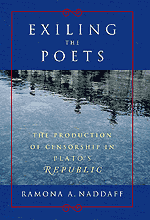
Naddaff, Ramona A., Exiling the Poets: The Production of Censorship in Plato's Republic, University of Chicago Press, 2003, 192 p.
ISBN: 0-226-56727-3
Description de l'éditeur:
The question of why Plato censored poetry in his Republic has bedeviled scholars for centuries. In Exiling the Poets, Ramona A. Naddaff offers a strikingly original approach to this problem, reading Plato's censorship as a creative and transformative act intended to produce literature, philosophy, and a reciprocal relationship between them.
Naddaff's approach identifies two distinct censorships in the Republic. With his first censorship, in books 2 and 3, Plato constitutes poetry as literature that matters and the poet as a legitimate (though ultimately vanquished) rival of the philosopher. In book 10's second censorship, Plato exiles the poets as a mode of self-subversion, thereby rethinking and revising his theories of mimesis, the soul, and, most important, his first censorship of poetry. Finally, with the poetic myth of Er, Plato censors his own censorships of poetry, thus producing the unexpected result of a poetically animated and open-ended dialectical philosophy.
Exiling the Poets will interest not just classicists, philosophers, and historians of rhetoric but anyone concerned with the historical contexts of censorship.
Table of Contents
Preface
Acknowledgments
INTRODUCTION
The Other Side of Censorship: Literature on Trial
1. The "Miserable Inventions" of Poets
"And There Will Be Poets"
A Tradition of Poetic Truth Tellers
Behind the Veil of Censorship
2. New Songs Are Best
Socrates' "Homericide"
"They Could Be Heroes": The Guardians' Poetic Education
Another Way to Sing a Song: Student, Rhapsodist, and Poet
3. The Making of the Poet's Image
From Identity to Difference
The Philosopher on the Couch: From Creators to Imitators
Dangerous Mimetic Images and Artists
Finally, the Poet
4. The Death of Poetry, the Poetry of Death
Eternal Returns
The Civil War of the Divided Soul
Enslaving Reason: Sympathy for the Other
Conclusion: A Myth to End . . . All Myths
Innovative Action and Conservative Reaction
Production, Repression, and Self-Subversion
Notes
Bibliography
Index