Fabula, la recherche en littérature (actu)

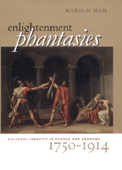
Enlightenment Phantasies

Parution livre

Information publiée le mercredi 26 mai 2004 par René Audet


_blank

Harold Mah, Enlightenment Phantasies, Cornell University Press, 2004.
ISBN: 0-8014-8895-8

Description donnée par l'éditeur :

For centuries the histories of France and Germany have been linked in ways productive and destructive, and each nation's sense of itself has often been shaped by admiration of or hostility toward the other. Harold Mah explores the interweaving paths of German and French cultural identity that emerged in the Enlightenment and continued through the nineteenth century and into the twentieth.

Mah argues that the efforts of German and French intellectuals and artists to formulate stable cultural identities constantly collapsed in the face of other powerful images and the rush of history. In Mah's view, these shifting conceptions of cultural identity are problematic phantasies, internally unstable and prone to falling apart under the pressure of events, only to be replaced by new, equally problematic constructions. Mah offers fresh analyses of a wide range of iconic texts and artworks, including those of Jacques-Louis David, de Staël, Diderot, and Rousseau in France and Goethe, Hegel, Herder, Mann, Marx, and Nietzsche in Germany.

Mah's book examines how attempts to define cultural identities were caught up in issues of language, gender, classical revival, politics, and modernity. Enlightenment Phantasies presents the shaping of cultural identity in narratives accessible not only to specialists but also to students and all readers concerned with the history of Western culture.


Harold Mah teaches European cultural and intellectual history at Queen's University, Canada. He is the author of The End of Philosophy, The Origin of Ideology: Karl Marx and the Crisis of the Young Hegelians.


Derniers ouvrages parus :

P. Engel, Les Lois de l'esprit. Julien Benda ou la raison

Laurence Brogniez (dir.), Écrits voyageurs. Les artistes et l'ailleurs

O. Biaggini, B. Milland-Bove (dir.), Miracles d'un autre genre  

Sévigné, Lettres de l'année 1671

A. Pope & J. Swift, Pensées sur différents sujets

H. Melville, Le Marchand de paratonnerres, suivi de La Véranda

Le Dit des Heiké

S. Kierkegaard, La Crise et une crise dans la vie d'une actrice

E. Maigret et M. Stefanelli (dir.), La Bande dessinée : une médiaculture

I. Raynauld, Lire et écrire un scénario - Le Scénario de film comme texte

J.-F. Bédia, Les Ecritures africaines face à la logique actuelle du comparatisme

Eusèbe de Césarée, Histoire ecclésiastique. Commentaire - Tome I : Études d'introduction

P. Engel, Les lois de l'esprit, Julien Benda ou la raison  

P. E. Fobah, Introduction à une poétique et une stylistique de la littérature africaine

M.-C. Alexandrine-Sinapah, Itinéraire d'un esclave-poète à Cuba - Juan Francisco Manzano (1797-1854) entre littérature et histoire

Cl. Launchbury, Music, Poetry, Propaganda. Constructing French Cultural Soundscapes at the BBC during the Second World War 

O. Rosenthal, Ils ne sont pour rien dans mes larmes

A. Alciato, Il libro degli Emblemi, secondo le edizioni del 1531 e del 1534

Marc Azéma, La Préhistoire du cinéma

J. Milly, Au seuil de l'image

I. Mons, Lou Andreas-Salomé. En toute liberté

N. Redouane, Lecture(s) de Rachid Mimouni

Chr. Martin (dir.), Fictions de l'origine (1650-1800)

D. Brooks, The Sons of Clovis : Ern Malley, Adoré Floupette and a Secret History of Australian Poetry

Jean Richepin, Truandailles

Fil d'informations RSS Fil d'information RSS   Fabula sur Facebook Fabula sur Facebook   Fabula sur Twitter Fabula sur Twitter