Fabula, la recherche en littérature (actu)

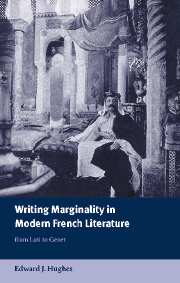
E.J. Hughes, Writing Marginality in Modern French Literature. From Loti to Genet

Parution livre

Information publiée le mercredi 3 mai 2006 par Julien Desrochers


_blank

HUGHES, Edward J., Writing Marginality in Modern French Literature. From Loti to Genet, Cambridge University Press (Cambridge Studies in French, 67), 2006, 221 p.

ISBN : 9780521025782

Writing Marginality in Modern French Literature explores how cultural centres require the peripheral, the outlawed and the deviant in order to define and bolster themselves. It analyses the hierarchies of cultural value which inform the work of six modern French writers: the exoticist Pierre Loti; Paul Gauguin, whose Noa Noa enacts European fantasies about Polynesia; Proust, who analyses such exemplary figures of exclusion and inclusion as the homosexual and the xenophobe; Montherlant, who claims to subvert colonialist values in La Rose de sable; Camus, who pleads an alienating detachment from the cultures of both metropolitan France and Algeria; and Jean Genet. Crucially Genet, who was typecast as France's moral pariah, in charting Palestinian statelessness in his last work, Un Captif amoureux (1986), reflects ethically on the dispossession of the Other and the violence inherent in the West's marginalization of cultural difference.

Contents:

Acknowledgments

Abbreviations

Introduction

1. Without obligation: exotic appropriation in Loti and Gauguin

2. Exemplary inclusions, indecent exclusions in Proust's Recherche

3. Claiming cultural dissidence: the case of Montherlant's La Rose de sable

4. Camus and the resistance to history

5. Peripheries, public and private: Genet and dispossession

Conclusion

Notes

Bibliography

Index.


Url de référence :
http://www.cambridge.org/uk/


Derniers ouvrages parus :

Lexique nomade

A. Cousin de Ravel, Quignard, Maître de lecture. Lire, vivre, écrire

P. Engel, Les Lois de l'esprit. Julien Benda ou la raison

Laurence Brogniez (dir.), Écrits voyageurs. Les artistes et l'ailleurs

O. Biaggini, B. Milland-Bove (dir.), Miracles d'un autre genre  

Sévigné, Lettres de l'année 1671

A. Pope & J. Swift, Pensées sur différents sujets

H. Melville, Le Marchand de paratonnerres, suivi de La Véranda

Le Dit des Heiké

S. Kierkegaard, La Crise et une crise dans la vie d'une actrice

E. Maigret et M. Stefanelli (dir.), La Bande dessinée : une médiaculture

I. Raynauld, Lire et écrire un scénario - Le Scénario de film comme texte

J.-F. Bédia, Les Ecritures africaines face à la logique actuelle du comparatisme

Eusèbe de Césarée, Histoire ecclésiastique. Commentaire - Tome I : Études d'introduction

P. Engel, Les lois de l'esprit, Julien Benda ou la raison  

P. E. Fobah, Introduction à une poétique et une stylistique de la littérature africaine

M.-C. Alexandrine-Sinapah, Itinéraire d'un esclave-poète à Cuba - Juan Francisco Manzano (1797-1854) entre littérature et histoire

Cl. Launchbury, Music, Poetry, Propaganda. Constructing French Cultural Soundscapes at the BBC during the Second World War 

O. Rosenthal, Ils ne sont pour rien dans mes larmes

A. Alciato, Il libro degli Emblemi, secondo le edizioni del 1531 e del 1534

Marc Azéma, La Préhistoire du cinéma

J. Milly, Au seuil de l'image

I. Mons, Lou Andreas-Salomé. En toute liberté

N. Redouane, Lecture(s) de Rachid Mimouni

Chr. Martin (dir.), Fictions de l'origine (1650-1800)

Fil d'informations RSS Fil d'information RSS   Fabula sur Facebook Fabula sur Facebook   Fabula sur Twitter Fabula sur Twitter