Fabula, la recherche en littérature (actu)

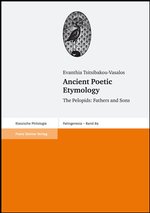
E. Tsitsibakou-Vasalos, Ancient Poetic Etymology. The Pelopids: Fathers and Sons.

Parution livre

Information publiée le mardi 29 juillet 2008 par Bérenger Boulay


_blank

Evanthia Tsitsibakou-Vasalos, Ancient Poetic Etymology. The Pelopids: Fathers and Sons.


Stuttgart: Franz Steiner Verlag, coll. "Palingenesia. Schriftenreihe für Klassische Altertumswissenschaft" n°89, 2007, 264p.

Isbn(ean13) 978-3-515-08939-5. €52.00.

Recension par Michael Paschalis (University of Crete) dans Bryn Mawr Classical Review: 2008.07.58

Présentation de l'éditeur:

The potential of ancient Greek poetic etymologizing and its reception in antiquity are analyzed with new interpretive models.
The author studies poetic etymology in a holistic and integrative manner, as a tool of thematic and narrative unification. Select passages from Homer and archaic lyric poetry provide the matrix for etymological patterns; their validity is examined in an intertextual study of the names of Pelops and his kin.
This family exhibits a consistent naming system: the signifiers and signifieds of its male members manifest a lexical and semantic affinity; fathers and sons are linked with inherited linguistic and behavioral bonds. Pelops is given a focal position on account of his preeminence at Olympia and his polyvalent and polysemous name, in which the ambiguities and polarities of his mythic and cultic identity are embedded.


Associate Professor in the Aristotelian University of Thessaloniki, School of Philology, Department of Classics. Major areas of research and publication: Homer, Archaic Lyric Poetry and Poetic Etymology.


Url de référence :
http://www.steiner-verlag.de/sachgebiete/altertumswissenschaften/altphilologie/einzeltitel-altphilologie/view/titel/55793.html


Derniers ouvrages parus :

Gérard de Nerval, Choix des poésies de Ronsard, Du Bellay, Baïf, Belleau, Du Bartas, Chassignet, Desportes, Régnier (éd. E. Buron / J.-N. Illouz)

Lexique nomade

A. Cousin de Ravel, Quignard, Maître de lecture. Lire, vivre, écrire

P. Engel, Les Lois de l'esprit. Julien Benda ou la raison

Laurence Brogniez (dir.), Écrits voyageurs. Les artistes et l'ailleurs

O. Biaggini, B. Milland-Bove (dir.), Miracles d'un autre genre  

Sévigné, Lettres de l'année 1671

A. Pope & J. Swift, Pensées sur différents sujets

H. Melville, Le Marchand de paratonnerres, suivi de La Véranda

Le Dit des Heiké

S. Kierkegaard, La Crise et une crise dans la vie d'une actrice

E. Maigret et M. Stefanelli (dir.), La Bande dessinée : une médiaculture

I. Raynauld, Lire et écrire un scénario - Le Scénario de film comme texte

J.-F. Bédia, Les Ecritures africaines face à la logique actuelle du comparatisme

Eusèbe de Césarée, Histoire ecclésiastique. Commentaire - Tome I : Études d'introduction

P. Engel, Les lois de l'esprit, Julien Benda ou la raison  

P. E. Fobah, Introduction à une poétique et une stylistique de la littérature africaine

M.-C. Alexandrine-Sinapah, Itinéraire d'un esclave-poète à Cuba - Juan Francisco Manzano (1797-1854) entre littérature et histoire

Cl. Launchbury, Music, Poetry, Propaganda. Constructing French Cultural Soundscapes at the BBC during the Second World War 

O. Rosenthal, Ils ne sont pour rien dans mes larmes

A. Alciato, Il libro degli Emblemi, secondo le edizioni del 1531 e del 1534

Marc Azéma, La Préhistoire du cinéma

J. Milly, Au seuil de l'image

I. Mons, Lou Andreas-Salomé. En toute liberté

N. Redouane, Lecture(s) de Rachid Mimouni

Fil d'informations RSS Fil d'information RSS   Fabula sur Facebook Fabula sur Facebook   Fabula sur Twitter Fabula sur Twitter