Fabula, la recherche en littérature (actu)

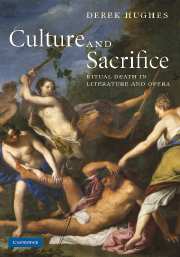
D. Hughes, Culture and Sacrifice. Ritual Death in Literature and Opera

Parution livre

Information publiée le mardi 4 décembre 2007 par Gabriel Marcoux-Chabot (source : Site web de la maison d'édition)


_blank

HUGHES, Derek, Culture and Sacrifice. Ritual Death in Literature and Opera, New York, Cambridge University Press, 2007, 326 p.
ISBN-13 9780521867337


RÉSUMÉ

Human sacrifice has fascinated Western writers since the beginnings of European literature. It is prominent in Greek epic and tragedy, and returned to haunt writers after the discovery of the Aztec mass sacrifices. It has been treated by some of the greatest creative geniuses, including Shakespeare and Wagner, and was a major topic in the works of many Modernists, such as D. H. Lawrence and Stravinsky. In literature, human sacrifice is often used to express a writer's reaction to the residue of barbarism in his own culture. The meaning attached to the theme therefore changes profoundly from one period to another, yet it remains as timely an image of cultural collapse as it did over two thousand years ago. Drawing on sources from literature and music, Derek Hughes examines the representation of human sacrifice in Western culture from the Iliad to the invasion of Iraq.


TABLE DES MATIÈRES

1. Human sacrifice, ancient and modern

2. Greece

3. Virgil to Augustine

4. The discovery of America

5. Shakespeare and the economics of sacrifice

6. Britain and America: Dryden, Behn, and Defoe

7. Lieto Fine: Baroque and Enlightenment sacrifice

8. The French Revolution to Napoleon

9. The secularization of sacrifice

10. Gothic sacrifice

11. Wagner

12. The second coming of Dionysius

13. Pentheus 1913

14. Sparagmos

15. Hitler and after

Bibliography.


Url de référence :
http://www.cambridge.org/us/catalogue/catalogue.asp?isbn=0521867339


Derniers ouvrages parus :

O. Biaggini, B. Milland-Bove (dir.), Miracles d'un autre genre  

Sévigné, Lettres de l'année 1671

A. Pope & J. Swift, Pensées sur différents sujets

H. Melville, Le Marchand de paratonnerres, suivi de La Véranda

Le Dit des Heiké

S. Kierkegaard, La Crise et une crise dans la vie d'une actrice

E. Maigret et M. Stefanelli (dir.), La Bande dessinée : une médiaculture

I. Raynauld, Lire et écrire un scénario - Le Scénario de film comme texte

J.-F. Bédia, Les Ecritures africaines face à la logique actuelle du comparatisme

Eusèbe de Césarée, Histoire ecclésiastique. Commentaire - Tome I : Études d'introduction

P. Engel, Les lois de l'esprit, Julien Benda ou la raison  

P. E. Fobah, Introduction à une poétique et une stylistique de la littérature africaine

M.-C. Alexandrine-Sinapah, Itinéraire d'un esclave-poète à Cuba - Juan Francisco Manzano (1797-1854) entre littérature et histoire

Cl. Launchbury, Music, Poetry, Propaganda. Constructing French Cultural Soundscapes at the BBC during the Second World War 

O. Rosenthal, Ils ne sont pour rien dans mes larmes

A. Alciato, Il libro degli Emblemi, secondo le edizioni del 1531 e del 1534

Marc Azéma, La Préhistoire du cinéma

J. Milly, Au seuil de l'image

I. Mons, Lou Andreas-Salomé. En toute liberté

N. Redouane, Lecture(s) de Rachid Mimouni

Chr. Martin (dir.), Fictions de l'origine (1650-1800)

D. Brooks, The Sons of Clovis : Ern Malley, Adoré Floupette and a Secret History of Australian Poetry

Jean Richepin, Truandailles

C. Meyer-Plantureux, Romain Rolland - Théâtre et engagement

C. Aliberti, Du spasme existentiel à la quête de rédemption

Fil d'informations RSS Fil d'information RSS   Fabula sur Facebook Fabula sur Facebook   Fabula sur Twitter Fabula sur Twitter