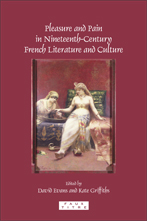
D. Evans, K. Griffiths (dir.), Pleasure and Pain in Nineteenth-Century French Literature and Culture
EVANS, David et Kate GRIFFITH (dir.), Pleasure and Pain in Nineteenth-Century French Literature and Culture, Amsterdam / New York, Rodopi coll. "Faux Titre" n°324, 2008, 286 p.
- ISBN 978-90-420-2502-8
RÉSUMÉ
From Sade at one end of the nineteenth century to Freud at the other,via many French novelists and poets, pleasure and pain become ever moreclosely entwined. Whereas the inseparability of these themes hashitherto been studied from isolated perspectives, such aspsychoanalysis, sadism and sado-masochism, melancholy, orpost-structuralist textual jouissance, the originality of thiscollaborative volume lies in its exploration of how pleasure and painfunction across a broader range of contexts. The essays collected heredemonstrate how the complex relationship between pleasure and painplays a vital role in structuring nineteenth-century thinking in prosefiction (Balzac, Flaubert, Musset, Maupassant, Zola), verse and thememoir as well as socio-cultural studies, medical discourses, aesthetictheory and the visual arts. Featuring an international selection ofcontributors representing the full range of approaches to scholarshipin nineteenth-century French studies – historical, literary, cultural,art historical, philosophical, and sociopolitical – the volume atteststo the vitality, coherence and interdisciplinarity ofnineteenth-century French studies and will be of interest to a widecross-section of scholars and students of French literature, societyand culture.
TABLE DES MATIÈRES
List of Illustrations
David EVANS and Kate GRIFFITHS: Introduction
Part I: The Novel
Henri MITTERAND : Jouir / souffrir: le sensible et la fiction
Michael TILBY: Balzac's Convivial Narrations: Intoxication and its Discourse in ‘La Comédie humaine'
Francesco MANZINI: The Zero-Sum Game of Providential Pain: Balzac's L'Envers de l'histoire contemporaine
Part II: Crime and Punishment
Anne-Emmanuelle DEMARTINI : L'Affaire Lacenaire ou les jouissances de l'exhibitionnisme criminel au temps du romantisme
Loïc GUYON : Le sex-appeal de la Veuve: guillotine et fantasmes romantiques
Natalia LECLERC : Le ‘bonheur dans le crime': le plaisir de perdre et de se perdre chez Barbey d'Aurevilly
Part III: Écritures féminines
Anna NORRIS : Marie Cappelle Lafarge ou l'écriture de la douleur
Sara JAMES: Malvina Blanchecotte and ‘la douleur chantée': the Creation of a Female Poetic Self
Rachel MESCH: Sexual Healing: Power and Pleasure in Fin-de-siècle Women's Writing
Part IV: Defining Sexual Experience
Gretchen SCHULTZ : La Rage du plaisir et la rage de la douleur: Lesbian Pleasure and Suffering in Fin-de-siècle French Literature and Sexology
Alison MOORE: Pathologizing Female Sexual Frigidity in Fin-de-siècle France, or How Absence Was Made into a Thing
ElizabethSTEPHENS: Redefining Sexual Excess as a Medical Disorder: Fin-de-siècleRepresentations of Hysteria and Spermatorrhoea
Part V: Aesthetics, Beauty and the Visual Arts
Rae Beth GORDON: What is Ugly? Taine, Allen, Moreau
Carol RIFELJ : ‘Il faut souffrir pour être belle': Pain and Beauty in Prose Fiction
Claire MORAN: Creative Crucifixions: The Artist as Christ in Nineteenth-Century France and Belgium
Notes on Contributors
Index
BIOGRAPHIE
David Evans is Lecturer in French at the University of St Andrews. His publications include Rhythm, Illusion and the Poetic Idea: Baudelaire, Rimbaud, Mallarmé(Rodopi, 2004) and articles on nineteenth and twentieth-century Frenchpoetry, in particular Théodore de Banville and Michel Houellebecq.
KateGriffiths is Lecturer in French at Swansea University. She haspublished widely on the questions of adaptation, citation and borrowingin nineteenth-century contexts and recently completed an AHRC-supportedmonograph: Emile Zola: Authorship and Adaptation.