Fabula, la recherche en littérature (actu)

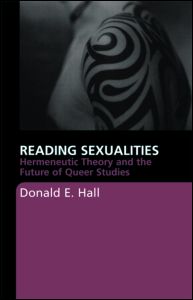
D. E. Hall, Reading Sexualities. Hermeneutic Theory and the Future of Queer Studies

Parution livre

Information publiée le jeudi 12 mars 2009 par Gabriel Marcoux-Chabot (source : Site web de la maison d'édition)


_blank

HALL, Donald E., Reading Sexualities. Hermeneutic Theory and the Future of Queer Studies, New York / Abingdon, Routledge, 2009, 152 p.

ISBN 978-0-415-36786-8

RÉSUMÉ

Reading Sexualities confronts the reigning practices, priorities, and preoccupations of queer theory and sexuality studies. Looking at a range of texts, from novels to travel narratives to internet porn, Donald E. Hall deftly weaves the theoretical with the literary in order to:

- examine the vexed ethical, critical, and political questions arising from sexual consumerism and cross-cultural encounters

- read the changing landscape of sexual identity, finding great cause for optimism and enthusiastic engagement

- urge readers to embrace a far-reaching dialogic practice as a mechanism for furthering radical social change.

Reading Sexualities shows how our sexual desires and bases for identification are being widely challenged and changed. Drawing on hermeneutic theory and the work of Hans-Georg Gadamer, Hall argues that by approaching sexual diversity with openness and humility, we become active participants in the politically urgent process of reading the self through the perspective of the other.

BIOGRAPHIE

Donald E. Hall is Jackson Distinguished Professor of English and Chair of the Department of English at West Virginia University. He is a long-time political activist, and the author or editor of nine previous books in the fields of gender studies, higher education studies, and Victorian studies. These include Fixing Patriarchy, RePresenting Bisexualities, Queer Theories, and Subjectivity.


Responsable : Donald E. Hall

Url de référence :
http://www.routledge.com/books/Reading-Sexualities-isbn9780415367868


Derniers ouvrages parus :

A. Pope & J. Swift, Pensées sur différents sujets

H. Melville, Le Marchand de paratonnerres, suivi de La Véranda

Le Dit des Heiké

S. Kierkegaard, La Crise et une crise dans la vie d'une actrice

E. Maigret et M. Stefanelli (dir.), La Bande dessinée : une médiaculture

I. Raynauld, Lire et écrire un scénario - Le Scénario de film comme texte

J.-F. Bédia, Les Ecritures africaines face à la logique actuelle du comparatisme

Eusèbe de Césarée, Histoire ecclésiastique. Commentaire - Tome I : Études d'introduction

P. Engel, Les lois de l'esprit, Julien Benda ou la raison  

P. E. Fobah, Introduction à une poétique et une stylistique de la littérature africaine

M.-C. Alexandrine-Sinapah, Itinéraire d'un esclave-poète à Cuba - Juan Francisco Manzano (1797-1854) entre littérature et histoire

Cl. Launchbury, Music, Poetry, Propaganda. Constructing French Cultural Soundscapes at the BBC during the Second World War 

O. Rosenthal, Ils ne sont pour rien dans mes larmes

A. Alciato, Il libro degli Emblemi, secondo le edizioni del 1531 e del 1534

Marc Azéma, La Préhistoire du cinéma

J. Milly, Au seuil de l'image

I. Mons, Lou Andreas-Salomé. En toute liberté

N. Redouane, Lecture(s) de Rachid Mimouni

Chr. Martin (dir.), Fictions de l'origine (1650-1800)

D. Brooks, The Sons of Clovis : Ern Malley, Adoré Floupette and a Secret History of Australian Poetry

Jean Richepin, Truandailles

C. Meyer-Plantureux, Romain Rolland - Théâtre et engagement

C. Aliberti, Du spasme existentiel à la quête de rédemption

M. Kadima-Nzuji, Théâtre et destin national au Congo-Kinshasa - 1965-1990

Jean-Yves Tadié, Le lac inconnu - Entre Proust et Freud

Fil d'informations RSS Fil d'information RSS   Fabula sur Facebook Fabula sur Facebook   Fabula sur Twitter Fabula sur Twitter