Fabula, la recherche en littérature (actu)

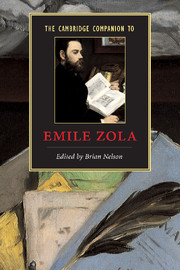
Brian Nelson (ed.), The Cambridge Companion to Zola

Parution livre

Information publiée le dimanche 1 avril 2007 par Julien Desrochers


_blank


Brian Nelson (ed.)

The Cambridge Companion to Zola

Cambridge University Press

2007, 246 p.


ISBN-13: 9780521543767


Emile Zola is a towering literary figure of the nineteenth century. His main literary achievement was his twenty-volume novel cycle, Les Rougon-Macquart (1870–93). In this series he combines a novelist's skills with those of the investigative journalist to examine the social, sexual and moral landscape of the late nineteenth century in a way that scandalized bourgeois society. In 1898 Zola crowned his literary career with a political act, his famous open letter ('J'accuse…!') to the President of the French Republic in defence of Alfred Dreyfus. These newly commissioned essays offer readings of individual novels as well as analyses of Zola's originality, his representation of society, sexuality and gender, his relations with the painters of his time, his narrative art, and his role in the Dreyfus Affair. The Companion also includes a chronology, detailed summaries of all of Zola's novels, suggestions for further reading, and information about specialist resources.


CONTENTS :


Chronology;

Zola's novels: a summary;

Family tree of the Rougon-Macquart;

1. Zola and the nineteenth century. Brian Nelson;

2. Family histories and family plots. Nicholas White;

3. Zola and the representation of society. Sandy Petrey;

4. Questions of sexuality and gender. Hannah Thompson;

5. Zola and contemporary painting. Robert Lethbridge;

6. Zola and the art of fiction. Chantal Pierre-Gnassounou;

7.Thérèse Raquin: animal passion and the brutality of reading. Susan Harrow;

8. Nana: the world, the flesh and the devil. Valerie Minogue;

9. Germinal: the gathering storm. David Baguley;

10. La Bête humaine: the poetics of the unconscious. Rae Beth Gordon;

11. Zola's utopias. Julia Przybos;

12. 'J'accuse…!': Zola and the Dreyfus Affair. Owen Morgan;

Further reading and specialist resources.


CONTRIBUTORS :


Brian Nelson, Nicholas White, Sandy Petrey, Hannah Thompson, Robert Lethbridge, Chantal Pierre-Gnassounou, Susan Harrow, Valerie Minogue, David Baguley, Rae Beth Gordon, Julia Przybos, Owen Morgan


Url de référence :
http://www.cambridge.org/us/


Derniers ouvrages parus :

Rudy Le Menthéour, La Manufacture de maladies. La dissidence hygiénique de Jean-Jacques Rousseau

Christine Hammann, Déplaire au public : le cas Rousseau

A. Biancofiore, Pasolini - Devenir d'une création

N. Sabri, La Kahéna - Un mythe à l'image du Maghreb

N. Aubert, Christian Dotremont. La Conquête du monde par l'image

R. Faure et  C. Cusset, Silves grecques 2012-2013 : Apollonios de Rhodes, Argonautiques III ; Xénophon, le Banquet et Apologie de Socrate

B. Joly, Descartes et la chimie

A. Dominguez Leiva, S Hubier, F. Toudoire-Surlarpierre, Le comparatisme, un univers en 3D?

L. Boltanski, Enigmes et complots - Une enquête à propos d'enquêtes

P.-M. de Biasi, Génétique des textes

G. Cavalcanti, Rime

M. Foucault, Préface à la transgression

 Llewellyn BROWN (dir.) : Samuel Beckett 2 : "Parole, regard et corps"

Fabrice GALTIER & Robin GLINATSIS Silves latines 2012-2013 : Horace, Satires, I et II, 1-3 ; Tacite, Annales, I-II.

P. Dirkx & P. Mougin (dir.), Claude Simon : situations

M. Murat & Fr. Worms (dir.), Alain, littérature et philosophie mêlées

C. Lozier, De l'abject et du sublime. G. Bataille, J.Genet, S. Beckett

F. Gaudin (dir.), Alain Rey, vocabuliste français

Aurélie Adler, Eclats des vies muettes. Figures du minuscule et du marginal dans les récits d'A. Ernaux, P. Bergounioux et F. Bon

François Noudelmann, Tombeaux, d'après La Mer de la fertilité de Mishima

A. Gatti, La Traversée des langages

A. Moeglin-Delcroix, Esthétique du livre d’artiste. Une introduction à l’art contemporain (rééd.)

C. Habib (dir.), Eduquer selon la nature. 16 études sur Emile de Rousseau

S. Bouquet, Clint Fucking Eastwood

U. Krampl, Les Secrets des faux sorciers. Police, magie et escroquerie à Paris au XVIIIe siècle

Fil d'informations RSS Fil d'information RSS   Fabula sur Facebook Fabula sur Facebook   Fabula sur Twitter Fabula sur Twitter