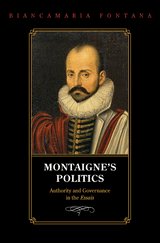
FONTANA, Bianca, Montaigne's Politics : Authority and Governance in the Essais, Princeton, Princeton University Press, 2008, 216 p.
ISBN 13: 978-0-691-13122-1
RÉSUMÉ
Michel de Montaigne (1533-92) is principally known today as a literary figure--the inventor of the modern essay and the pioneer of autobiographical self-exploration who retired from politics in midlife to write his private, philosophical, and apolitical Essais. But, as Biancamaria Fontana argues in Montaigne's Politics, a novel, vivid account of the political meaning of the Essais in the context of Montaigne's life and times, his retirement from the Bordeaux parliament in 1570 "could be said to have marked the beginning, rather than the end, of his public career." He later served as mayor of Bordeaux and advisor to King Henry of Navarre, and, as Fontana argues, Montaigne's Essais very much reflect his ongoing involvement and preoccupation with contemporary politics--particularly the politics of France's civil wars between Catholics and Protestants. Fontana shows that the Essais, although written as a record of Montaigne's personal experiences, do nothing less than set forth the first major critique of France's ancien régime, anticipating the main themes of Enlightenment writers such as Voltaire and Diderot. Challenging the views that Montaigne was politically aloof or evasive, or that he was a conservative skeptic and supporter of absolute monarchy, Fontana explores many of the central political issues in Montaigne's work--the reform of legal institutions, the prospects of religious toleration, the role of public opinion, and the legitimacy of political regimes.
TABLE DES MATIÈRES
Acknowledgments vii
Introduction 1
1. The Spirit of the Laws 26
2. In a Leaden Century: The Decline of Virtue 45
3. Freedom of Conscience: The Politics of Toleration 66
4. Freedom of Conscience: Governing Opinion 85
5. Turning the Tide: Trust and Legitimacy 104
6. Learning from Experience: Politics as Practice 122
Conclusion : Montaigne's Legacy 141
Notes 147
Bibliography 183
Index 203
BIOGRAPHIE
Biancamaria Fontana is professor of the history of political ideas at the University of Lausanne in Switzerland. Her books include Rethinking the Politics of Commercial Society and Benjamin Constant and the Post-Revolutionary Mind.