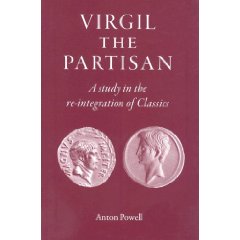
Anton Powell, Virgil the Partisan: A Study in the Re-Integration of Classics, Swansea: Classical Press of Wales, 2008. xi, 309 pages.
- ISBN 9781905125210
- $69.50
Recension par Román Facundo Espino (Universidad Nacional del Sur) dans Bryn Mawr Classical Review 2009.03.37.
Présentation de l'éditeur:
Virgil has been claimed as an ancestor by partisans of recentcenturies: he has been seen as forerunner of Christianity, as a gentle`national poet' following World War II, as a kindred spirit foropponents of the Vietnam War, and recently as a critic of man's damageto the natural environment. However, most - except the young - feelthat Virgil was not often concerned to express support forOctavian-Augustus. This near-consensus of literary critics rests on thetendency of political historians to skim the period between 44 and31BC, and thus to ignore most aspects of Octavian's contemporaryreputation. This book applies a historian's eye to the poetry ofVirgil's work. It challenges the orthodoxy that Virgil was a faithfulfollower of inherited literary genre. It attends closely to hisdeviations from poetic tradition, and argues that - after the eclogues- those deviations form a pattern: Virgil has identified, addressed andsought to palliate, structurally and on a grand scale, the ugliest andmost damaging aspects of Octavian's reputation. His Aeneas steals theclothes of Octavian's most powerful and popular opponent, a man -unlike Mark Antony - little noticed by modern historians. This studyinsists on the need to combine scholarly disciplines: to argue closelyfrom Virgil's Latin, and from Greek literary genre - and to inform sucharguments with a knowledge of ancient political writing and ofcontemporary coinage. The Virgil who emerges is a more purposive,bloodstained and courageous individual than most have wished to see.Powell's book aims to become a reference for all those who address - inwhatever spirit - the question whether Virgil was deeply engaged in thepolitics of his time.
Anton Powell is Directorof the University of Wales Institute of Classics. He is the author ofAthens and Sparta (1988, 2001); as founder and (with Stephen Hodkinson)as director of the International Sparta Seminar he has edited fivevolumes of its proceedings. He is also (with Kathryn Welch) editor ofJulius Caesar as Artful Reporter (1998) and of Sextus Pompeius (2002).
Table des matières:
Acknowledgements and Prefatory Note (ix)
Chronology (xi)
Part 1: Studying Virgil and the established partisan: the Aeneid
1. Studying Virgil: several types of circularity-and an escape (3)
2. The theft of pietas (31)
3. Recovering Sicily (87)
4. The peopling of the underworld: Aeneid 6.608-27 (133)
5. Aeneas, sex and misery (149)
Part 2: Partisan in the making: the Eclogues and Georgics
6. The Eclogues (181)
7. The Georgics: the fate of the Muses (227)
8. Conclusion (283)
9. Bibliography (291)
10. Index (301)