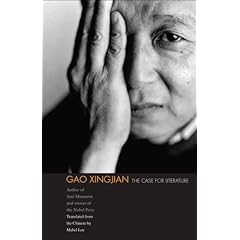
Gao XINGJIAN, The Case for Literature, New Haven, Yale University Press, 2007, 192 p.
ISBN 9780300124217
ISBN-10 030012421X
SUMMARY
When Gao Xingjian was crowned Nobel Laureate in 2000, it was the firsttime in the hundred-year history of the Nobel Prize that this honor hadbeen awarded to an author for a body of work written in Chinese. Thesame year, American readers embraced Mabel Lee’s translation of Gao’slyrical and autobiographical novel Soul Mountain, making it anational bestseller. Gao’s plays, novels, and short fiction have wonthe Chinese expatriate an international following and a place among theworld’s greatest living writers.
The bold and extraordinary essays in this volume—all beautifully translated by sinologist Mabel Lee—include Gao's Nobel Lecture (“The Case for Literature”), “Literature as Testimony: The Search for Truth,” “Cold Literature,” “Literature and Metaphysics: About Soul Mountain,” and “The Necessity of Loneliness,” as well as other essays. These essays embody an argument for literature as a universal human endeavor rather than one defined and limited by national boundaries. Gao believes in the need for the writer to stand apart from collective movements, regardless of whether these are engineered by political parties or driven by economic or other forces not related to literature. This collection presents Gao's innovative ideas on aesthetics, and it constitutes the very kernel of his thinking on literary creation.
ABOUT THE AUTHOR
Playwright, novelist, essayist, and painter Gao Xingjian was bornin 1940 in Jiangxi Province in eastern China. Choosing exile, hesettled in Paris in 1987. In 1992, he was named a Chevalier de l'Ordredes Arts et des Lettres by the French government. In 2000, he wasawarded the Nobel Prize in Literature. Mabel Lee’s many translationsinclude Gao Xingjian’s novels Soul Mountain and One Man’s Bible and his short story collection Buying a Fishing Rod for My Grandfather. She is an honorary associate in the School of Languages and Culture at the University of Sydney.