Fabula, la recherche en littérature (actu)

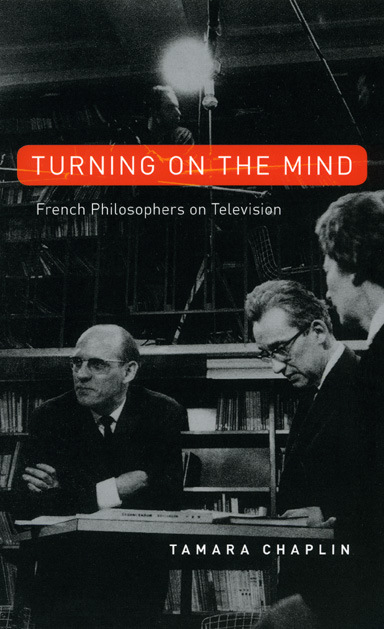
T. Chaplin, Turning On the Mind : French Philosophers on Television

Parution livre

Information publiée le mercredi 16 janvier 2008 par Gabriel Marcoux-Chabot (source : Site web de la maison d'édition)


_blank

CHAPLIN, Tamara, Turning On the Mind : French Philosophers on Television, Chicago, University of Chicago Press, 2007, 272 p.
ISBN 978-0-226-50991-4


RÉSUMÉ

In 1951, the eight o'clock nightly news reported on Jean-Paul Sartre for the first time. By the end of the twentieth century, more than 3,500 programs dealing with philosophy and its practitioners—including Bachelard, Badiou, Foucault, Lyotard, and Lévy—had aired on French television. According to Tamara Chaplin, this enduring commitment to bringing the most abstract and least visual of disciplines to the French public challenges our very assumptions about the incompatibility of elite culture and mass media. Indeed, it belies the conviction that television is inevitably anti-intellectual and the quintessential archenemy of the book.

Chaplin argues that the history of the televising of philosophy is crucial to understanding the struggle over French national identity in the postwar period. Linking this history to decolonization, modernization, and globalization, Turning On the Mind claims that we can understand neither the markedly public role that philosophy came to play in French society during the late twentieth century nor the renewed interest in ethics and political philosophy in the early twenty-first unless we acknowledge the work of television. Throughout, Chaplin insists that we jettison presumptions about the anti-intellectual nature of the visual field, engages critical questions about the survival of national cultures in a globalizing world, and encourages us to rethink philosophy itself, ultimately asserting that the content of the discipline is indivisible from the new media forms in which it has found expression.


Url de référence :
http://www.press.uchicago.edu/cgi-bin/hfs.cgi/00/220933.ctl


Derniers ouvrages parus :

Lexique nomade

A. Cousin de Ravel, Quignard, Maître de lecture. Lire, vivre, écrire

P. Engel, Les Lois de l'esprit. Julien Benda ou la raison

M. Crouzet, M. Myself ou La Vie de Stendhal (nouvelle version)

Laurence Brogniez (dir.), Écrits voyageurs. Les artistes et l'ailleurs

O. Biaggini, B. Milland-Bove (dir.), Miracles d'un autre genre  

Sévigné, Lettres de l'année 1671

A. Pope & J. Swift, Pensées sur différents sujets

H. Melville, Le Marchand de paratonnerres, suivi de La Véranda

Le Dit des Heiké

S. Kierkegaard, La Crise et une crise dans la vie d'une actrice

E. Maigret et M. Stefanelli (dir.), La Bande dessinée : une médiaculture

I. Raynauld, Lire et écrire un scénario - Le Scénario de film comme texte

J.-F. Bédia, Les Ecritures africaines face à la logique actuelle du comparatisme

Eusèbe de Césarée, Histoire ecclésiastique. Commentaire - Tome I : Études d'introduction

P. Engel, Les lois de l'esprit, Julien Benda ou la raison  

P. E. Fobah, Introduction à une poétique et une stylistique de la littérature africaine

M.-C. Alexandrine-Sinapah, Itinéraire d'un esclave-poète à Cuba - Juan Francisco Manzano (1797-1854) entre littérature et histoire

Cl. Launchbury, Music, Poetry, Propaganda. Constructing French Cultural Soundscapes at the BBC during the Second World War 

O. Rosenthal, Ils ne sont pour rien dans mes larmes

A. Alciato, Il libro degli Emblemi, secondo le edizioni del 1531 e del 1534

Marc Azéma, La Préhistoire du cinéma

J. Milly, Au seuil de l'image

I. Mons, Lou Andreas-Salomé. En toute liberté

N. Redouane, Lecture(s) de Rachid Mimouni

Fil d'informations RSS Fil d'information RSS   Fabula sur Facebook Fabula sur Facebook   Fabula sur Twitter Fabula sur Twitter