Fabula, la recherche en littérature (actu)

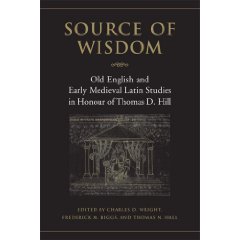
Source of Wisdom: Old English and Early Medieval Latin Studies in Honour of Thomas D. Hill

Parution livre (collectif)

Information publiée le jeudi 30 octobre 2008 par Bérenger Boulay


_blank


Source of Wisdom: Old English and Early Medieval Latin Studies in Honour of Thomas D. Hill
, Toronto: University of Toronto Press,
2007, xxiv-420p.

Études rassemblées par Charles D. Wright, Frederick M. Biggs et Thomas N. Hall.

  Isbn 13 (ean): 978-0-8020-9367-7.

Recension par Nicole Guenther Discenza (University of South Florida) dans The Medieval Review (TMR 08.10.22)

Présentation de l'éditeur:

 As one of the most prolific and influential scholars in the field, Thomas D. Hill has made an indelible mark on the study of Old English literature. In celebration of his distinguished career, the editors of Source of Wisdom have assembled a wide-ranging collection of nineteen original essays on Old English poetry and prose as well as early medieval Latin, touching upon many of Hill's specific research interests.

Among the topics examined in this volume are the Christian-Latin sources of Old English texts, including religious and 'sapiential' poetry, and prose translations of Latin writings. Old English poems such as Beowulf, The Dream of the Rood, and The Wife's Lament are treated, throughout, to thematic, textual, stylistic, lexical, and source analysis. Prose writers of the period such as King Alfred and Wærferth, as well as medieval Latin writers such as Bede and Pseudo-Methodius are also discussed. As an added feature, the volume includes a bibliography of publications by Thomas D. Hill.

Source of Wisdom is, ultimately, a contribution to the understanding of medieval English literature and the textual traditions that contributed to its development.


Charles D. Wright is a professor in the Department of English at the University of Illinois, Urbana-Champaign.

Frederick M. Biggs is a professor in the Department of English at the University of Connecticut, Storrs.

Thomas N. Hall is an associate professor in the Department of English at the University of Notre Dame.


Derniers ouvrages parus :

Lexique nomade

A. Cousin de Ravel, Quignard, Maître de lecture. Lire, vivre, écrire

P. Engel, Les Lois de l'esprit. Julien Benda ou la raison

M. Crouzet, M. Myself ou La Vie de Stendhal (nouvelle version)

Laurence Brogniez (dir.), Écrits voyageurs. Les artistes et l'ailleurs

O. Biaggini, B. Milland-Bove (dir.), Miracles d'un autre genre  

Sévigné, Lettres de l'année 1671

A. Pope & J. Swift, Pensées sur différents sujets

H. Melville, Le Marchand de paratonnerres, suivi de La Véranda

Le Dit des Heiké

S. Kierkegaard, La Crise et une crise dans la vie d'une actrice

E. Maigret et M. Stefanelli (dir.), La Bande dessinée : une médiaculture

I. Raynauld, Lire et écrire un scénario - Le Scénario de film comme texte

J.-F. Bédia, Les Ecritures africaines face à la logique actuelle du comparatisme

Eusèbe de Césarée, Histoire ecclésiastique. Commentaire - Tome I : Études d'introduction

P. Engel, Les lois de l'esprit, Julien Benda ou la raison  

P. E. Fobah, Introduction à une poétique et une stylistique de la littérature africaine

M.-C. Alexandrine-Sinapah, Itinéraire d'un esclave-poète à Cuba - Juan Francisco Manzano (1797-1854) entre littérature et histoire

Cl. Launchbury, Music, Poetry, Propaganda. Constructing French Cultural Soundscapes at the BBC during the Second World War 

O. Rosenthal, Ils ne sont pour rien dans mes larmes

A. Alciato, Il libro degli Emblemi, secondo le edizioni del 1531 e del 1534

Marc Azéma, La Préhistoire du cinéma

J. Milly, Au seuil de l'image

I. Mons, Lou Andreas-Salomé. En toute liberté

N. Redouane, Lecture(s) de Rachid Mimouni

Fil d'informations RSS Fil d'information RSS   Fabula sur Facebook Fabula sur Facebook   Fabula sur Twitter Fabula sur Twitter