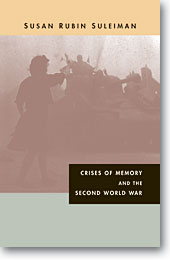
Crises of Memory and the Second World War
Susan Rubin Suleiman
Harvard UP
ISBN 0-674-02206
How we view ourselves and how we wish to be seen by others cannot be separated from the stories we tell about our past. In this sense all memory is in crisis, torn between conflicting motives of historical reflection, political expediency, and personal or collective imagination. In Crises of Memory and the Second World War, Susan Suleiman conducts a profound exploration of contested terrain, where individual memories converge with public remembrance of traumatic events.
Suleiman is one of a handful of scholars who have shaped the interdisciplinary study of memory, with its related concepts of trauma, testimony, forgetting, and forgiveness. In this book she argues that memories of World War II, while nationally specific, transcend national boundaries, due not only to the global nature of the war but also to the increasingly global presence of the Holocaust as a site of collective memory. Among the works she discusses are Jean-Paul Sartre's essays on the occupation and Resistance in France; Marcel Ophuls' innovative documentary on Klaus Barbie, tried for crimes against humanity; Istvan Szabo's film Sunshine, a chronicle of Jewish identity in central Europe; literary memoirs by Jorge Semprun and Elie Wiesel; and experimental writing by child survivors of the Holocaust.
Susan Rubin Suleiman is the Dillon Professor of the Civilization of France and Professor of Comparative Literature