Fabula, la recherche en littérature (actu)

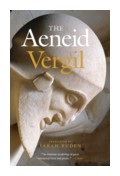
S. Ruden (éd.), Vergil, The Aeneid

Parution livre (édition)

Information publiée le mardi 19 mai 2009 par Judith Rohman (source : compitum.fr)


_blank

Sarah Ruden (éd.), Vergil, The Aeneid, New Haven: Yale University Press, XX, 2009. 320 pages. 9780300151411 16.95 $ Présentation de l'éditeur:


Selected by Choice magazine as an Outstanding Academic Title of 2008.

Selected as one of the Favorite Books of 2008 on Mr. Wilson's Bookshelf/Books & Culture

This extraordinary new translation of the Aeneid stands alone among modern Vergil translations for its accuracy and poetic appeal. Sarah Ruden, a lyric poet in her own right, is the first woman to translate Vergil's great epic, and she renders the poem in the same number of lines as the original work—a very rare feat that maintains technical fidelity to the original without diminishing its emotional power.

Ruden's translation follows Vergil's content faithfully, and the economy and fast pace she achieves are true to his own unflagging narrative force. With its central theme of national destiny versus. the destiny of individuals, the poem has great resonance in our own times, and Ruden adheres closely to the poet's message. Her rendering of Vergil's words gives immediacy to his struggling faith that history has beauty and purpose in spite of its pain. With this distinguished translation, modern readers can experience for themselves the timeless power of Vergil's masterpiece.

L'auteur:

Sarah Ruden's previous translations include Aristophanes' Lysistrata and Petronius' Satyricon. She is a visiting scholar at Yale Divinity School.

Extrait en ligne: http://yalepress.yale.edu/yupbooks/excerpts/vergil_aeneid.pdf


Url de référence :
http://yalepress.yale.edu/yupbooks/book.asp?isbn=9780300151411


Derniers ouvrages parus :

Théodore Augustin Mann, Mémoires sur les grandes gelées et leurs effets

L. Hébert & L. Guillemette (dir.), Performances et objets culturels. Nouvelles perspectives

R. Corona, Mots de l'enfermement - Clôtures et silences : lexique et rhétorique de la douleur du néant

J. Hillion, Shakespeare et son double - Les Sonnets de Shakespeare à la lumière de la théorie mimétique de René Girard

Alison Boulanger et Jessica Wilker, (éd.), La posture de l'herméneute. Essais sur l'interprétation dans la littérature

Nadia R. Altschul : Geographies of Philological Knowledge. Postcoloniality and the Transatlantic National Epic

A. Matei, Jean Echenoz et la distance intérieure

P. Citti, Taine, philosophe du récit

F. Parisot (dir.), Alejo Carpentier à l'aube du XXIème siècle

Chr. Chaulet Achour (dir.), À l'aube des Mille et Une Nuits. Lectures comparatistes

M. Méricam-Bourdet, Voltaire et l’écriture de l’histoire: un enjeu politique

J.-P. Cléro, E. Faye (dir.), Descartes, des principes aux phénomènes

D. Bellos, Le Poisson et le bananier. L'histoire fabuleuse de la traduction

J. Rancière, La Leçon d'Althusser

E. Zola, Mes haines (GF-Flammarion)

E. Zola, Correspondance (GF-Flammarion)

J. Caradonna, The Enlightenment in Practice: Academic Prize Contests and Intellectual Culture in France, 1670–1794

R. Le Menthéour, La Manufacture de maladies. La dissidence hygiénique de J.-J. Rousseau

C. Hammann, Déplaire au public : le cas Rousseau

A. Biancofiore, Pasolini - Devenir d'une création

N. Sabri, La Kahéna - Un mythe à l'image du Maghreb

N. Aubert, Christian Dotremont. La Conquête du monde par l'image

R. Faure et  C. Cusset, Silves grecques 2012-2013 : Apollonios de Rhodes, Argonautiques III ; Xénophon, le Banquet et Apologie de Socrate

B. Joly, Descartes et la chimie

A. Dominguez Leiva, S Hubier, F. Toudoire-Surlarpierre, Le comparatisme, un univers en 3D?

Fil d'informations RSS Fil d'information RSS   Fabula sur Facebook Fabula sur Facebook   Fabula sur Twitter Fabula sur Twitter