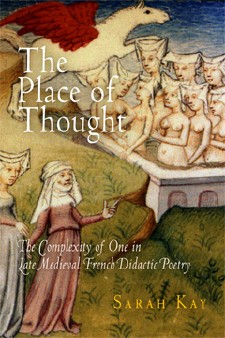
Sarah Kay, The Place of Thought: The Complexity of One in Late Medieval French Didactic Poetry. Philadelphia: University of Pennsylvania Press, coll. "Middle Ages Series", 2007, xii-233p.
Recension de cet ouvrage par Emma Campbell (University of Warwick) dans The Medieval Review: TMR 08.12.04
ISBN: 978-0-8122-4007-8.
Présentation de l'éditeur:
From Jean de Meun in the late thirteenth century to Christine dePizan in the early fifteenth, medieval French poets often aimed toimpart theological, philosophical, or moral ideas. To unify theirthought, and to make its outline visible to readers, the poets createdvivid images of place, such as gardens, paths, idyllic landscapes,cities, trees, and fountains. For Sarah Kay, these spatial images are aprop of "monologism," helping to communicate (or impose) unity ofmeaning and interpretation by summoning readers to occupy the same"place" in their thinking as the authors. Because of this monologism,Kay contends, didactic poetry has been ill served by a criticaltradition that favors difference, plurality, and dialogism. In The Place of Thought, she seeks radically to reassess this literature and reappraise the pleasure to be derived from reading it.
Kayargues that one meaning is not inherently simpler or less interestingthan many meanings. Using specific works as examples, she demonstratesthat this "one-ness" of thought in French didactic poems can be anexcitingly complex and challenging notion, and that it strains theimages in which it is placed to the point where they become difficultto visualize. Herein lies the poems' simultaneous intellectual andaesthetic appeal. Focusing on the Roman de la Rose by Jean de Meun, the Breviari d'amor by Matfre Ermengaud, the Ovide moralisé, Pèlerinage de vie humaine by Guillaume de Deguileville's, Le Jugement dou roy de Navarre by Guillaume de Machaut, Le Joli buisson de Jonece by Jean Froissart, and Le Livre du Chemin de long estudeby Christine de Pizan, Kay traces the works' backgrounds in scholasticthinking, illuminating them when appropriate with modern reflections onthe same ideas.
"This book is quite simply the most important,intellectually ambitious, and far-reaching endeavor in recentyears."—Stephen G. Nichols, Johns Hopkins University
"Aninvaluable resource not only for students of French medieval literaturebut for any reader interested in the conjunction of philosophy andpoetry."—Speculum
Sarah Kay is Professor of French at Princeton University.