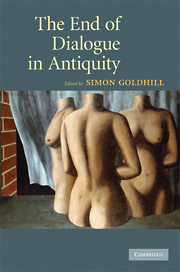
Simon Goldhill (dir.), The End of Dialogue in Antiquity, Cambridge/New York: Cambridge University Press, 2008. Pp. viii, 266.
- ISBN 9780521887748.
- $99.00.
Recension par Christopher Moore (The University of Texas at Austin) dans Bryn Mawr Classical Review 2010.02.25.
Extraits en ligne sur le site de l'éditeur et amazon.com.
Présentation de l'éditeur:
‘Dialogue' was invented as a written form in democratic Athens andmade a celebrated and popular literary and philosophical style byPlato. Yet it almost completely disappeared in the Christian empire oflate antiquity. This book, the first general and systematic study ofthe genre in antiquity, asks: who wrote dialogues and why? Why diddialogue no longer attract writers in the later period in the same way?Investigating dialogue goes to the heart of the central issues ofpower, authority, openness and playfulness in changing culturalcontexts. This book analyses the relationship between literary form andcultural authority in a new and exciting way, and encourages closerreflection about the purpose of dialogue in its wider social, culturaland religious contexts in today's world.
simon goldhill is Professor of Greek at the University of Cambridge and a Fellow of King's College. He has published widely on many aspects of Greek literature, including Reading Greek Tragedy (1986), Foucault's Virginity (1995), Who Needs Greek? (2002) and How to Stage Greek Tragedy Today (2007). He is in demand as a lecturer all over the world and is a regular broadcaster on radio and television.
Table des matières:
Notes on Contributors vii
Introduction: Why don't Christians do dialogue? Simon Goldhill 1
Part I Classical models 13
1 Fictions of dialogue in Thucydides Emily Greenwood 15
2 The beginnings of dialogue: Socratic discourses and fourth-century prose Andrew Ford 29
3 Plato's dialogues and a common rationale for dialogue form Alex Long 45
Part II Empire models 61
4 Ciceronian dialogue Malcolm Schofield 63
5 Sympotic dialogue in the first to fifth centuries CE Jason König 85
Part III Christianity and the theological imperative 115
6 Can we talk? Augustine and the possibility of dialogue Gillian Clark 117
7 ‘Let's (not) talk about it': Augustine and the control of epistolary dialogue Richard Miles 135
Part IV Christianity and the social imperative 149
8 Christians, dialogues and patterns of sociability in late antiquity Richard Lim 151
9 Boethius, Gregory the Great and the Christian ‘afterlife' of classical dialogue Kate Cooper and Matthew Dal Santo 173
Part V Judaism and the limits of dialogue 191
10 No dialogue at the symposium? Conviviality in Ben Sira and the Palestinian Talmud Seth Schwartz 193
11 Dialectic and divination in the Talmud Daniel Boyarin 217
Bibliography 242
Index 263