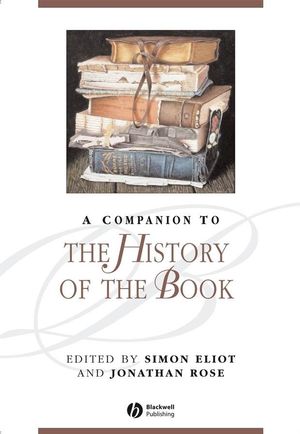
A Companion to the History of the Book, Wiley-Blackwell, coll. "Blackwell Companions", 2009 (2007), 616 p.
Sous la direction de Simon Eliot & Jonathan Rose
- ISBN: 978-1-4051-9278-1 (Paperback 2009)
- ISBN: 978-1-4051-2765-3 (Hardcover 2007)
- £24.99 / €30.00
Extrait 1 (PDF) Table (PDF) Index (PDF)
From the early Sumerian clay tablet through to the emergence of the electronic text, this Companion provides a continuous and coherent account of the history of the book.
- Makes use of illustrative examples and case studies of well-known texts
- Written by a group of expert contributors
- Covers topical debates, such as the nature of censorship and the future of the book
Simon Eliot is Professorof the History of the Book in the Institute of English Studies, part ofthe School of Advanced Study in the University of London, and DeputyDirector of the Centre for Manuscript and Print Studies. He is GeneralEditor of the new multivolume History of Oxford University Press and editor of the journal Publishing History. His publications include Literary Cultures and the Material Book (2007) and Some Patterns and Trends in British Publishing, 1800–1919 (1994).
Jonathan Roseis Professor of History at Drew University. He was the foundingpresident of the Society for the History of Authorship, Reading andPublishing and is co-editor of the journal Book History. His publications include The Intellectual Life of the British Working Classes (2001), The Holocaust and the Book: Destruction and Preservation (2001), and British Literary Publishing Houses, 1820–1965 (1991).
Sommaire:
Introduction (Simon Eliot and Jonathan Rose).
Part I: Methods and Approaches.
1. Why Bibliography Matters (T. H. Howard-Hill, editor of Papers of the Bibliographical Society of America).
2. What is Textual Scholarship? (David Greetham, City University of New York).
3. The Uses of Quantification (Alexis Weedon, University of Bedfordshire).
4. Readers: Books and Biography (Stephen Colclough, University of Wales, Bangor).
Part II: The History of the Material Text.
The World before the Codex.
5. The Clay Tablet Book in Sumer, Assyria, and Babylonia (Eleanor Robson, University of Cambridge).
6. The Papyrus Roll in Egypt, Greece, and Rome (Cornelia Roemer, Austrian National Library).
The Book beyond the West.
7. China (J. S. Edgren, Chinese Rare Books Project).
8. Japan, Korea, and Vietnam (Peter Kornicki, University of Cambridge).
9. South Asia (Graham Shaw, British Library).
10. Latin America (Hortensia Calvo, Tulane University).
11. The Hebraic Book (Emile G. L. Schrijver, Amsterdam University Library).
12. The Islamic Book (Michael Albin, independent scholar).
The Codex in the West 400–2000.
13. The Triumph of the Codex: The Manuscript Book before 1100 (Michelle P. Brown, University of London).
14. Parchment and Paper: Manuscript Culture 1100–1500 (M. T. Clanchy, University of London).
15. The Gutenberg Revolutions (Lotte Hellinga, formerly The British Library).
16. The Book Trade Comes of Age: The Sixteenth Century (David J. Shaw, Consortium of European Research Libraries).
17. The British Book Market 1600–1800 (John Feather, Loughborough University).
18. Print and Public in Europe 1600–1800 (Rietje van Vliet, journalist).
19. North America and Transatlantic Book Culture to 1800 (Russell L. Martin III, Southern Methodist University).
20. The Industrialization of the Book 1800–1970 (Rob Banham, University of Reading).
21. From Few and Expensive to Many and Cheap: The British Book Market 1800–1890 (Simon Eliot, University of London).
22. A Continent of Texts: Europe 1800–1890 (Jean-Yves Mollier,University of Versailles Saint-Quentin-en-Yvelines and Marie-FrançoiseCachin, University of Paris VII).
23. Building a National Literature: The United States 1800–1890 (Robert A. Gross, University of Connecticut).
24. The Globalization of the Book 1800–1970 (David Finkelstein, Queen Margaret College, Edinburgh).
25. Modernity and Print I: Britain 1890–1970 (Jonathan Rose, Drew University).
26. Modernity and Print II: Europe 1890–1970 (Adriaan van der Weel, University of Leiden).
27. Modernity and Print III: The United States 1890–1970 (Beth Luey, Arizona State University).
28. Books and Bits: Texts and Technology 1970–2000 (Paul Luna, University of Reading).
29. The Global Market 1970–2000: Producers (Eva Hemmungs Wirtén, Uppsala University).
30. The Global Market 1970–2000: Consumers (Claire Squires, Oxford Brookes University).
Part III: Beyond the Book.
31. Periodicals and Periodicity (James Wald, Hampshire College).
32. The Importance of Ephemera (Martin Andrews, University of Reading).
33. The New Textual Technologies (Charles Chadwyck-Healey, openDemocracy.net).
Part IV: Issues.
34. New Histories of Literacy (Patricia Crain, New York University).
35. Some Non-textual Uses of Books (Rowan Watson, Victoria and Albert Museum).
36. The Book as Art (Megan L. Benton, Pacific Lutheran University).
37. Obscenity, Censorship, and Modernity (Deana Heath, Trinity College Dublin).
38. Copyright and the Creation of Literary Property (John Feather, Loughborough University).
39. Libraries and the Invention of Information (Wayne A. Wiegand, Florida State University).
Coda.
40. Does the Book Have a Future? (Angus Phillips, Oxford Brookes University).